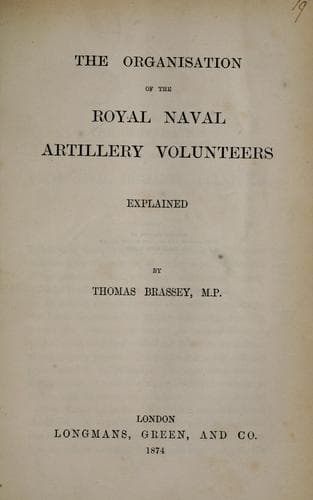
The Organisation of the Royal Naval Artillery Volunteers ExplainedBrassey, Thomas Brassey, Earl
History
The Organisation of the Royal Naval Artillery Volunteers Explained
Brassey, Thomas Brassey, Earl
Great Britain. Royal Naval Artillery Volunteers
[Sidenote: The officers of the corps.]
The principle upon which the Volunteers should be officered has been one
of the most frequent subjects of discussion among those who have
associated themselves with the movement from the commencement, and who
have been provisionally enrolled, with the sanction of the Admiralty, in
anticipation of the passing of the Act of Parliament of last year.
A desire has been expressed that no officers should be appointed to the
corps, but that the Volunteers should serve only under direct naval
command. Practically, the desire, so strongly felt, has been fulfilled
in the arrangements which have actually been made.
Whenever called upon to serve afloat, or when embarked for the purpose
of training, the Volunteers will be under the command of the officer,
commanding the ship, in which they may be. When embarked for their first
cruise in the autumn of the present year, the arrangements were, of
necessity, experimental and provisional. There was a natural desire on
the part of the officer commanding the 'Foam' to meet the wishes of the
Volunteers themselves in every possible way, consistent with the
efficient performance of the service, and the carrying on of the drills
and exercises required. The same considerate spirit will doubtless
prevail on all future occasions; but the Volunteers, who make themselves
acquainted with the regulations, will clearly perceive that, whenever
they embark, they place themselves under direct naval authority; and
that, when afloat, their own officers are never to assume any naval
command or authority whatever, unless ordered to do so by their superior
naval officers.
The officers of the Volunteers will do their utmost to assist the naval
officers to preserve discipline. They may, if they think fit, set an
example to their men by taking an active part in all the duties and
manual exercises. They may fall in at quarters, and take any number at
the gun. In short, they may become, as much as they please, active
working seamen and efficient practical gunners. It is for them to use
their own discretion in determining how much or how little they shall
participate in the manual labour, involved in carrying out the drills
and exercises ordered by the naval officers in command.
Public-domain text, read in full here on John Shaqi.
The Organisation of the Royal Naval Artillery Volunteers Explained — John Shaqi
Reviews
Reviews
No reviews yet
Be the first to share your thoughts on this work.
Join the Discussion
Join the discussion
Sign in to leave a comment or review.
Sign InorCreate an account