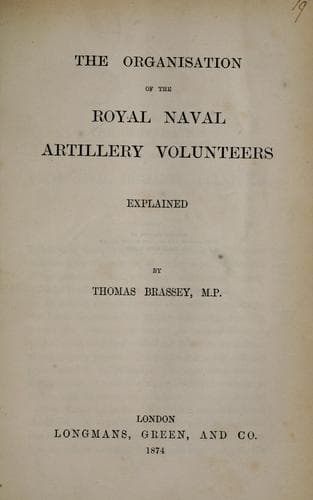
The Organisation of the Royal Naval Artillery Volunteers ExplainedBrassey, Thomas Brassey, Earl
History
The Organisation of the Royal Naval Artillery Volunteers Explained
Brassey, Thomas Brassey, Earl
Great Britain. Royal Naval Artillery Volunteers
It has been already stated that coast defence, and not service at sea,
constitutes the especial sphere proposed for the Royal Naval Artillery
Volunteers. The term coast defence is perhaps, in a certain sense, a
misnomer. The defence of the most important of our commercial harbours
against an attack from the sea could not be effectually conducted by a
force composed exclusively of men trained for the land service alone.
The approach to all the great ports of the United Kingdom from the sea
involves the navigation of extensive estuaries, where floating
batteries, and armed rafts, and the use of torpedoes, are essential to a
complete defence, and would in point of fact effectually prevent the
nearer approach of a hostile fleet. In the laying out of torpedoes on an
extensive scale, a flotilla of boats would be required; and in
furnishing crews for such boats, the well-trained oarsmen, who, it is
hoped, will be found willing to enroll themselves in the Royal Naval
Artillery Volunteers, would be enabled to render valuable service. In
all probability, by their co-operation in the hour of danger, they would
release an equal number of highly trained seamen, who would form the
crews of sea-going cruisers. All our greatest ports, London, Hull,
Newcastle, Leith and Granton, ports for Edinburgh, Glasgow, Bristol,
Southampton, Belfast, Dublin, Cork, are situated at the head of an
extensive estuary, or at some distance from the mouth of a navigable
river. The mere enumeration of these names is sufficient to show how
large a sphere there might be, in the event of a threatened invasion,
for the employment, in the important and essential task of harbour
defence, of an auxiliary force composed, not of trained seamen, but of
persons who may be described generally as aquatics.
It is to be observed that a mere oarsman, although not trained at the
great guns, or in the use of rifle and cutlass, would be enabled to do
good work in a service in which the use of boats must be largely
resorted to; and that, in order to take a number at a gun mounted on a
raft, such as the 'Nancy Dawson,' which the late Captain Cole improvised
for our naval operations in the Sea of Azof, or to serve in a gun's crew
in a floating battery for harbour defence, neither sea legs nor sea
experience are indispensable qualifications. For such duties those
qualities are required which equally combine to make a good gunner and a
good soldier, whether afloat or on shore--a fair share of physical
strength and activity, intelligence, and, above all, courage and
patriotism.
[Sidenote: The force need not be numerous.]
Public-domain text, read in full here on John Shaqi.
Reviews
Reviews
No reviews yet
Be the first to share your thoughts on this work.
Join the Discussion
Join the discussion
Sign in to leave a comment or review.
Sign InorCreate an account