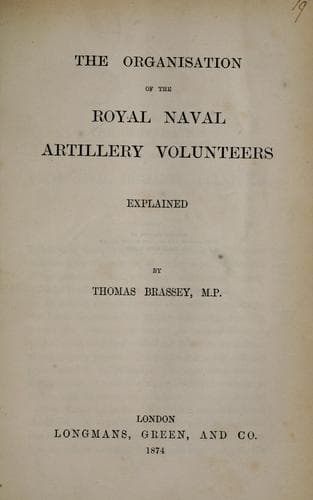
The Organisation of the Royal Naval Artillery Volunteers ExplainedBrassey, Thomas Brassey, Earl
History
The Organisation of the Royal Naval Artillery Volunteers Explained
Brassey, Thomas Brassey, Earl
Great Britain. Royal Naval Artillery Volunteers
Designed, as the Royal Naval Artillery Volunteers have been, for the
especial work of coast and harbour defence, it is not necessary that the
corps should be very numerous. It certainly need not exceed the numbers
of our amateur yachtsmen and oarsmen, for whom the opportunity, now
offered, of taking their share in the national defence, is chiefly
intended. Enough will have been done, if a brigade can be formed at each
of the principal ports, of a strength varying from 200 to 600 men.
[Sidenote: The training required.]
Having described the general scope of the duties, which would devolve on
the Royal Naval Artillery Volunteers, in the event of their being called
out for actual service, the nature of the training proposed for the
members of the force may be briefly explained. The first consideration
must be to familiarise them, to some extent, with the management of
boats. This instruction might occupy much time in a corps composed of
men, who had never been in the habit of going on the water; but, as the
Royal Naval Artillery Volunteer corps is to be recruited in a large
proportion from among aquatics, many of their number may be expected to
possess this qualification without the necessity for special
instruction.
The next point to claim attention will be the exercise at the great
guns. Here I may venture to affirm, from personal experience, that the
naval gun drills have been, in every detail, so carefully considered,
the instructors are so completely masters of the subject which they have
to teach, and the mechanical appliances are such effectual substitutes
for heavy manual labour, that a few days of constant attention will
suffice to make a volunteer a useful man in a gun's crew. The class of
recruits required for the Royal Navy Artillery Volunteers possess
advantages of intelligence and education, far beyond those which the
practical seamen can enjoy; and we may anticipate, from the experience
already acquired, that they will form some of the smartest gun's crews
in any branch of the naval service. There is neither insurmountable
difficulty, nor unduly fatiguing labour, in the drill at the great guns.
The intricacies could be mastered in a few days, if the volunteers were
kept continuously at drill, as they necessarily would be, should they
ever be called out for actual service.
The essential point in a volunteer corps is to secure men physically
capable of doing their work, and who may be confidently relied upon as
ready to serve, whenever they may be called upon.
The small-arm exercises are still more easily mastered. A rowing man
will find himself able to use his cutlass efficiently in a few hours;
and, after a couple of days of continuous drill, he would be able to go
through the manual and platoon exercises with satisfactory smartness and
precision.
Public-domain text, read in full here on John Shaqi.
Reviews
Reviews
No reviews yet
Be the first to share your thoughts on this work.
Join the Discussion
Join the discussion
Sign in to leave a comment or review.
Sign InorCreate an account