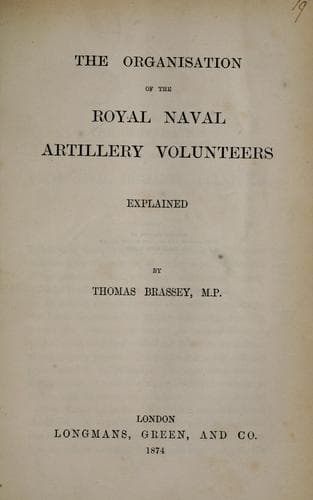
The Organisation of the Royal Naval Artillery Volunteers ExplainedBrassey, Thomas Brassey, Earl
History
The Organisation of the Royal Naval Artillery Volunteers Explained
Brassey, Thomas Brassey, Earl
Great Britain. Royal Naval Artillery Volunteers
The commanding officer of a corps is to give to any Volunteer, on his
quitting the corps, a certificate of discharge, when requested to do so
by such Volunteer.
Every member has power to withdraw from the corps upon giving 14 days'
notice to that effect.
Enrolled members are classed as efficients and non-efficients.
All enrolled members who do not fulfil the conditions above referred to
are reckoned as non-efficients.
Each brigade will be commanded by a lieutenant commanding.
Each battery will be commanded by a sub-lieutenant.
In each battery there will be, as it has already been stated, one chief
petty officer, two 1st class, and two 2nd class petty officers.
The petty officers of a battery will be selected by the commanding
officer of the battery.
When assembled for drill or inspection, the Volunteers will be under the
command of the senior naval officer of the district. When the Volunteers
are assembled for drill, the senior officer will be represented by the
officer instructor, a retired commander or gunnery lieutenant of the
Royal Navy, whose duty it will be to see that all drills are properly
carried out.
When afloat, the Volunteers are to be, in all matters whatsoever, under
the command of the captain or commanding officer of the ship in which
they may be.
The authority of the officers commanding batteries is strictly limited
to their own batteries only. The discipline will be the same throughout
the corps, and will be enforced by the lieutenant commanding the
brigade, in conformity with the regulations issued by the Admiralty.
The lieutenant commanding will make arrangements for drill, securing, so
far as it may be necessary, separate hours for each battery. Before
adopting any final arrangements for drill, he will confer with the
officer instructor.
There may be an occasional general muster of the corps, when considered
necessary by the lieutenant commanding.
The batteries will take precedence at general parades according to their
numbers, and not according to the seniority of their respective
commanding officers.
The brigade staff will not be attached to a battery, but will act under
the lieutenant commanding only.
Officers of the Royal Naval Artillery Volunteers rank with, but after,
officers of the Royal Navy and Royal Naval Reserve of their respective
ranks.
All officers of the Royal Naval Artillery Volunteers will be
commissioned by the Admiralty.
The commanding officers of brigades will recommend, for the
consideration of the Admiralty, names of persons for the appointments
and promotion of officers in their brigades.
The appointment of an honorary commander to a brigade is allowed, and
such honorary lieutenants and sub-lieutenants as the Admiralty may think
fit to sanction.
Officers in full pay in the Navy or Army are not eligible for other than
honorary commissions.
The uniform approved for the officers resembles generally that worn by
officers of the Naval Reserve, silver being substituted for gold lace.
Public-domain text, read in full here on John Shaqi.
Reviews
Reviews
No reviews yet
Be the first to share your thoughts on this work.
Join the Discussion
Join the discussion
Sign in to leave a comment or review.
Sign InorCreate an account