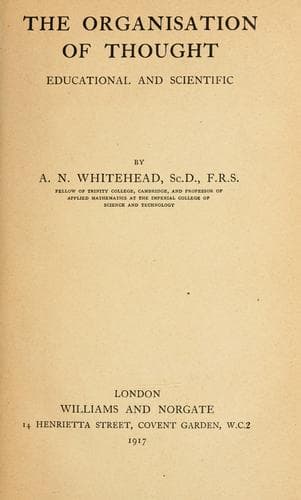
The organisation of thought, educational and scientificWhitehead, Alfred North
Philosophy
The organisation of thought, educational and scientific
Whitehead, Alfred North
Education
First, let us take the ultimate basis of any theory of relativity.
All space measurement is from stuff in space to stuff in space. The
geometrical entities of empty space never appear. The only geometrical
properties of which we have any direct knowledge are properties of
those shifting, changeable appearances which we call things in space.
It is the sun which is distant, and the ball which is round, and the
lamp-posts which are in linear order. Wherever mankind may have got its
idea of an infinite unchangeable space from, it is safe to say that it
is not an immediate deliverance of direct observation.
There are two antagonistic philosophical ways of recognising this
conclusion.
One is to affirm that space and time are conditions for sensible
experience, that without projection into space and time sensible
experience would not exist. Thus, although it may be true to say that
our knowledge of space and time is given in experience, it is not true
to say that it is deduced from experience in the same sense that the
Law of Gravitation is so deduced. It is not deduced, because in the act
of experiencing we are necessarily made aware of space as an infinite
given whole, and of time as an unending uniform succession. This
philosophical position is expressed by saying that space and time are
_a priori_ forms of sensibility.
The opposed philosophical method of dealing with the question is
to affirm that our concepts of time and space are deductions from
experience, in exactly the same way as the Law of Gravitation is such
a deduction. If we form exact concepts of points, lines and surfaces,
and of successive instants of time, and assume them to be related as
expressed by the axioms of geometry and the axioms for time, then we
find that we have framed a concept which, with all the exactness of
which our observations are capable, expresses the facts of experience.
These two philosophic positions are each designed to explain a
certain difficulty. The _a priori_ theory explains the absolute
universality ascribed to the laws of space and time, a universality
not ascribed to any deduction from experience. The experiential theory
explains the derivation of the space-time concepts without introducing
any other factors beyond those which are admittedly present in framing
the other concepts of physical science.
But we have not yet done with the distinctions which in any discussion
of space or time must essentially be kept in mind. Put aside the
above question as to how these space-time concepts are related to
experience--What are they when they are formed?
Public-domain text, read in full here on John Shaqi.
Reviews
Reviews
No reviews yet
Be the first to share your thoughts on this work.
Elsewhere in the archive
Join the Discussion
Join the discussion
Sign in to leave a comment or review.
Sign InorCreate an account