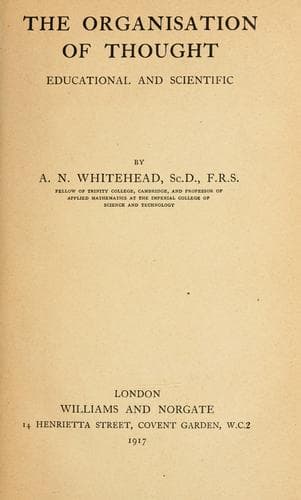
The organisation of thought, educational and scientificWhitehead, Alfred North
Philosophy
The organisation of thought, educational and scientific
Whitehead, Alfred North
Education
Science only renders the metaphysical need more urgent. In itself
it contributes little directly to the solution of the metaphysical
problem. But it does contribute something, namely, the exposition of
the fact that our experience of sensible apparent things is capable of
being analysed into a scientific theory, a theory not indeed complete,
but giving every promise of indefinite expansion. This achievement
emphasises the intimate relation between our logical thought and the
facts of sensible apprehension. Also the special form of scientific
theory is bound to have some influence. In the past false science
has been the parent of bad metaphysics. After all, science embodies
a rigorous scrutiny of one part of the whole evidence from which
metaphysicians deduce their conclusions.
FOOTNOTES:
[Footnote 3: Cf. _Révue de Métaphysique et de Morale_, May 1916,
where this question is dealt with by the author at the end of an
article, "La théorie relationniste de l'espace."]
CHAPTER VIII
SPACE, TIME, AND RELATIVITY
(_Paper read to Section A at the Manchester Meeting of the British
Association, 1915, and later before the Aristotelian Society_)
FUNDAMENTAL Problems concerning space and time have been considered
from the standpoints created by many different sciences. The object of
this paper is the humble one of bringing some of these standpoints into
relation with each other. This necessitates a very cursory treatment of
each point of view.
Mathematical physicists have evolved their theory of relativity to
explain the negative results of the Morley-Michelson experiment and of
the Trouton experiment. Experimental psychologists have considered the
evolution of spatial ideas from the crude sense-data of experience.
Metaphysicians have considered the majestic uniformity of space and
time, without beginning and without end, without boundaries, and
without exception in the truths concerning them; all these qualities
the more arresting to our attention from the confused accidental
nature of the empirical universe which is conditioned by them.
Mathematicians have studied the axioms of geometry, and can now deduce
all that is believed to be universally true of space and of time by the
strictest logic from a limited number of assumptions.
These various lines of thought have been evolved with surprisingly
little interconnection. Perhaps it is as well. The results of science
are never quite true. By a healthy independence of thought perhaps we
sometimes avoid adding other people's errors to our own. But there can
be no doubt that the normal method of cross-fertilising thought is by
considering the same, or allied problems to our own, in the form which
they assume in other sciences.
Here I do not propose to enter into a systematic study of these various
chapters of science. I have neither the knowledge nor the time.
Public-domain text, read in full here on John Shaqi.
Reviews
Reviews
No reviews yet
Be the first to share your thoughts on this work.
Elsewhere in the archive
Join the Discussion
Join the discussion
Sign in to leave a comment or review.
Sign InorCreate an account