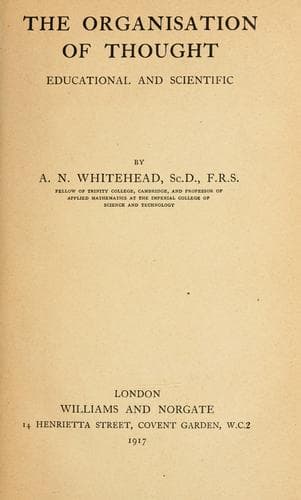
The organisation of thought, educational and scientificWhitehead, Alfred North
Philosophy
The organisation of thought, educational and scientific
Whitehead, Alfred North
Education
Many diverse experiments have been made, and they all agree in
concluding that a man who assumes the earth to be at rest will find by
measurement that the velocity of light is the same in all directions.
Furthermore, when the same man turns his attention to interstellar or
interplanetary phenomena, and assumes the sun to be at rest, he will
again find the velocity of light to be the same in all directions.
These are well-attested experiments made at long intervals of time.
This is the exact contingency contemplated above.
Again the velocity of light _in vacuo_ has recently taken on a
new dignity. It used to be one among other wave velocities such as
the velocity of sound in air, or in water, or the velocity of surface
waves in water. But Clerk Maxwell discovered that all electromagnetic
influences are propagated with the velocity of light, and now modern
physical science half suspects that electromagnetic influences are
the only physical influences which relate the changes in the physical
world. Accordingly the velocity of light becomes the fundamental
natural velocity, and experiment shows that our judgment of its
magnitude is not affected by our choice of the framework at rest, so
long as we keep to a set of dynamical axes. These experiments on light
have been confirmed by other electromagnetic experiments not involving
light.
Thus we are driven to equations (II), where V is the velocity of light.
The first conclusion to be drawn from equations (II) is that two people
who make different choices of bodies at rest will disagree as to
their measuring rods in the way described above. There is no peculiar
difficulty about that. The only wonder is that all people agree so well
in their judgments as to metrical systems. A mathematical angel would
naturally expect incarnate men to be in violent disagreement on this
subject.
But the case of time is different. For simplicity of statement we speak
of A as at O, and B as at O′. We remember that O′ is moving relatively
to O with velocity _v_ in direction OO′. Suppose A and B are
looking in this direction; and they both measure their time from the
instant when they met, as O′ passed over O. Then we have
T = ((_t_ - _vx_)/V^2)/((1 - _v_^2)/V^2).
Now, suppose we consider all the events all over space which A
considers to have happened simultaneously at the time _t_. The
events of this set which occurred anywhere on a plane perpendicular to
OO′ at a distance _x_ in front of O (according to A's reckoning),
will have occurred according to B's reckoning at the time T as given
above. Let us fix our attention on the fact that B does not consider
all these events to be simultaneous. For let T_{1}, and T_{2} be B's
times for such events on planes _x__{1}, and _x__{2}. Then
T_{1} - T_{2} = _v_(_x__{2} - _x__{1})/(V^2 - _v_^2).
Public-domain text, read in full here on John Shaqi.
Reviews
Reviews
No reviews yet
Be the first to share your thoughts on this work.
Elsewhere in the archive
Join the Discussion
Join the discussion
Sign in to leave a comment or review.
Sign InorCreate an account