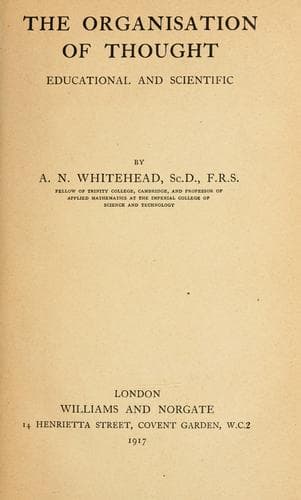
The organisation of thought, educational and scientificWhitehead, Alfred North
Philosophy
The organisation of thought, educational and scientific
Whitehead, Alfred North
Education
Thus if _x__{2} be greater than _x__{1}, T_{2} is less than
T_{1}. Thus B judges the more distant events in front of him to have
happened earlier than the nearer events in front of him, and _vice
versa_ for the events behind. This disturbance of the judgment of
simultaneity is the fundamental fact. Obviously the measurement of time
intervals is a detail compared to simultaneity. A may think a sermon
long, and B may think it short, but at least they should both agree
that it stopped when the clock hand pointed at the hour. The worst of
the matter is that so far as any test can be applied there is no method
of discriminating between the validities of their judgments.
Thus we are confronted with two distinct concepts of the common world,
A's space-time concept, and B's space-time concept. Who is right? It is
no use staying for an answer. We must follow the example of the wise
old Roman, and pass on to other things.
Thus estimates of quantity in space and time, and, to some extent, even
estimates of order, depend on the individual observer. But what are
the crude deliverances of sensible experience, apart from that world
of imaginative reconstruction which for each of us has the best claim
to be called our real world? Here the experimental psychologist steps
in. We cannot get away from him. I wish we could, for he is frightfully
difficult to understand. Also, sometimes his knowledge of the
principles of mathematics is rather weak, and I sometimes suspect----
No, I will not say what I sometimes think: probably he, with equal
reason, is thinking the same sort of thing of us.
I will, however, venture to summarise conclusions, which are, I
believe, in harmony with the experimental evidence, both physical and
psychological, and which are certainly suggested by the materials for
that unwritten chapter in mathematical logic which I have already
commended to your notice. The concepts of space and time and of
quantity are capable of analysis into bundles of simpler concepts. In
any given sensible experience it is not necessary, or even usual, that
the whole complete bundle of such concepts apply. For example, the
concept of externality may apply without that of linear order, and the
concept of linear order may apply without that of linear distance.
Again, the abstract mathematical concept of a space-relation
may confuse together distinct concepts which apply to the given
perceptions. For example, linear order in the sense of a linear
projection from the observer is distinct from linear order in the sense
of a row of objects stretching across the line of sight.
Mathematical physics assumes a given world of definitely related
objects, and the various space-time systems are alternative ways of
expressing those relations as concepts in a form which also applies to
the immediate experience of observers.
Public-domain text, read in full here on John Shaqi.
Reviews
Reviews
No reviews yet
Be the first to share your thoughts on this work.
Elsewhere in the archive
Join the Discussion
Join the discussion
Sign in to leave a comment or review.
Sign InorCreate an account