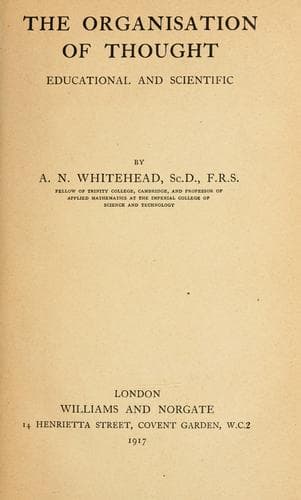
The organisation of thought, educational and scientificWhitehead, Alfred North
Philosophy
The organisation of thought, educational and scientific
Whitehead, Alfred North
Education
Yet there must be one way of expressing the relations between objects
in a common external world. Alternative methods can only arise as the
result of alternative standpoints; that is to say, as the result of
leaving something added by the observer sticking (as it were) in the
universe.
But this way of conceiving the world of physical science, as composed
of hypothetical objects, leaves it as a mere fairy tale. What is really
actual are the immediate experiences. The task of deductive science
is to consider the concepts which apply to these data of experience,
and then to consider the concepts relating to these concepts, and
so on to any necessary degree of refinement. As our concepts become
more abstract, their logical relations become more general, and less
liable to exception. By this logical construction we finally arrive
at conceptions, (i) which have determinate exemplifications in the
experience of the individuals, and (ii) whose logical relations have
a peculiar smoothness. For example, conceptions of mathematical time,
of mathematical space, are such smooth conceptions. No one lives in
"an infinite given whole," but in a set of fragmentary experiences.
The problem is to exhibit the concepts of mathematical space and time
as the necessary outcome of these fragments by a process of logical
building up. Similarly for the other physical concepts. This process
builds a common world of conceptions out of fragmentary worlds of
experience. The material pyramids of Egypt are a conception, what is
actual are the fragmentary experiences of the races who have gazed on
them.
So far as science seeks to rid itself of hypothesis, it cannot go
beyond these general logical constructions. For science, as thus
conceived, the divergent time orders considered above present no
difficulty. The different time systems simply register the different
relations of the mathematical construct to those individual
experiences (actual or hypothetical) which could exist as the crude
material from which the construct is elaborated.
But after all it should be possible so to elaborate the mathematical
construct so as to eliminate specific reference to particular
experiences. Whatever be the data of experience, there must be
something which can be said of them as a whole, and that something is
a statement of the general properties of the common world. It is hard
to believe that with proper generalisation time and space will not be
found among such properties.
_Commentary added on reading the Paper before the Aristotelian
Society_
The first six pages of the paper consist of a summary of ideas which
ought to be in our minds while considering problems of time and space.
The ideas are mostly philosophical, and the summary has been made by
an amateur in that science; so there is no reason to ascribe to it any
importance except that of a modest reminder. There are only two points
in this summary to which I would draw attention.
Public-domain text, read in full here on John Shaqi.
Reviews
Reviews
No reviews yet
Be the first to share your thoughts on this work.
Elsewhere in the archive
Join the Discussion
Join the discussion
Sign in to leave a comment or review.
Sign InorCreate an account