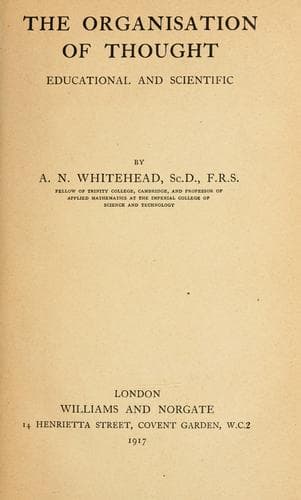
The organisation of thought, educational and scientificWhitehead, Alfred North
Philosophy
The organisation of thought, educational and scientific
Whitehead, Alfred North
Education
The conclusion to be drawn from this discussion is, that alike for
masters and for men a technical or technological education, which is to
have any chance of satisfying the practical needs of the nation, must
be conceived in a liberal spirit as a real intellectual enlightenment
in regard to principles applied and services rendered. In such an
education geometry and poetry are as essential as turning lathes.
The mythical figure of Plato may stand for modern liberal education
as does that of St. Benedict for technical education. We need not
entangle ourselves in the qualifications necessary for a balanced
representation of the actual thoughts of the actual men. They are used
here as symbolic figures typical of antithetical notions. We consider
Plato in the light of the type of culture he now inspires.
In its essence a liberal education is an education for thought and
for æsthetic appreciation. It proceeds by imparting a knowledge of
the masterpieces of thought, of imaginative literature, and of art.
The action which it contemplates is command. It is an aristocratic
education implying leisure. This Platonic ideal has rendered
imperishable services to European civilisation. It has encouraged art,
it has fostered that spirit of disinterested curiosity which is the
origin of science, it has maintained the dignity of mind in the face of
material force, a dignity which claims freedom of thought. Plato did
not, like St. Benedict, bother himself to be a fellow-worker with his
slaves; but he must rank among the emancipators of mankind. His type
of culture is the peculiar inspiration of the liberal aristocrat, the
class from which Europe derives what ordered liberty it now possesses.
For centuries, from Pope Nicholas V to the schools of the Jesuits, and
from the Jesuits to the modern headmasters of English public schools,
this educational ideal has had the strenuous support of the clergy.
For certain people it is a very good education. It suits their type
of mind and the circumstances amid which their life is passed. But
more has been claimed for it than this. All education has been judged
adequate or defective according to its approximation to this sole type.
The essence of the type is a large discursive knowledge of the best
literature. The ideal product of the type is the man who is acquainted
with the best that has been written. He will have acquired the chief
languages, he will have considered the histories of the rise and fall
of nations, the poetic expression of human feeling, and have read the
great dramas and novels. He will also be well grounded in the chief
philosophies, and have attentively read those philosophic authors who
are distinguished for lucidity of style.
Public-domain text, read in full here on John Shaqi.
Reviews
Reviews
No reviews yet
Be the first to share your thoughts on this work.
Join the Discussion
Join the discussion
Sign in to leave a comment or review.
Sign InorCreate an account