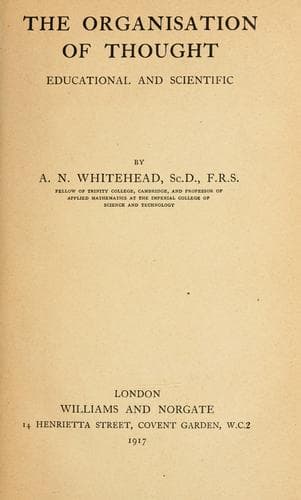
The organisation of thought, educational and scientific — John Shaqi
The organisation of thought, educational and scientificWhitehead, Alfred North
Philosophy
The organisation of thought, educational and scientific
Whitehead, Alfred North
Education
It is obvious that, except at the close of a long life, he will not
have much time for anything else if any approximation is to be made to
the fulfilment of this programme. One is reminded of the calculation
in a dialogue of Lucian that, before a man could be justified in
practising any one of the current ethical systems, he should have spent
a hundred and fifty years in examining their credentials.
Such ideals are not for human beings. What is meant by a liberal
culture is nothing so ambitious as a full acquaintance with the varied
literary expression of civilised mankind from Asia to Europe, and from
Europe to America. A small selection only is required; but then, as
we are told, it is a selection of the very best. I have my doubts of
a selection which includes Xenophon and omits Confucius, but then I
have read neither in the original. The ambitious programme of a liberal
education really shrinks to a study of some fragments of literature
included in a couple of important languages.
But the expression of the human spirit is not confined to literature.
There are the other arts, and there are the sciences. Also education
must pass beyond the passive reception of the ideas of others. Powers
of initiative must be strengthened. Unfortunately initiative does not
mean just one acquirement--there is initiative in thought, initiative
in action, and the imaginative initiative of art; and these three
categories require many subdivisions.
The field of acquirement is large, and the individual so fleeting and
so fragmentary: classical scholars, scientists, headmasters are alike
ignoramuses.
There is a curious illusion that a more complete culture was possible
when there was less to know. Surely the only gain was, that it was more
possible to remain unconscious of ignorance. It cannot have been a gain
to Plato to have read neither Shakespeare, nor Newton, nor Darwin.
The achievements of a liberal education have in recent times not been
worsened. The change is that its pretensions have been found out.
My point is, that no course of study can claim any position of ideal
completeness. Nor are the omitted factors of subordinate importance.
The insistence in the Platonic culture on disinterested intellectual
appreciation is a psychological error. Action and our implication in
the transition of events amid the evitable bond of cause to effect
are fundamental. An education which strives to divorce intellectual
or æsthetic life from these fundamental facts carries with it the
decadence of civilisation. Essentially culture should be for action,
and its effect should be to divest labour from the associations of
aimless toil. Art exists that we may know the deliverances of our
senses as good. It heightens the sense-world.
Public-domain text, read in full here on John Shaqi.
Reviews
Reviews
No reviews yet
Be the first to share your thoughts on this work.
Join the Discussion
Join the discussion
Sign in to leave a comment or review.
Sign InorCreate an account