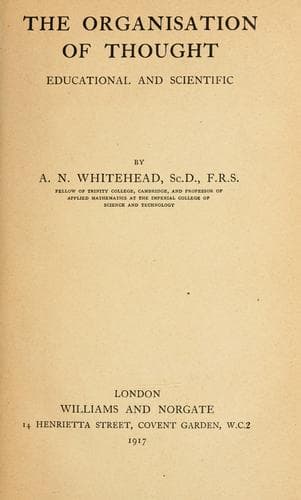
The organisation of thought, educational and scientificWhitehead, Alfred North
Philosophy
The organisation of thought, educational and scientific
Whitehead, Alfred North
Education
In the teaching of science, the art of thought should be taught:
namely, the art of forming clear conceptions applying to first-hand
experience, the art of divining the general truths which apply, the
art of testing divinations, and the art of utilising general truths
by reasoning to more particular cases of some peculiar importance.
Furthermore, a power of scientific exposition is necessary, so that the
relevant issues from a confused mass of ideas can be stated clearly,
with due emphasis on important points.
By the time a science, or a small group of sciences, has been taught
thus amply, with due regard to the general art of thought, we have gone
a long way towards correcting the specialism of science. The worst
of a scientific education based, as necessarily must be the case, on
one or two particular branches of science, is that the teachers under
the influence of the examination system are apt merely to stuff
their pupils with the narrow results of these special sciences. It is
essential that the generality of the method be continually brought to
light and contrasted with the speciality of the particular application.
A man who only knows his own science, as a routine peculiar to that
science, does not even know that. He has no fertility of thought, no
power of quickly seizing the bearing of alien ideas. He will discover
nothing, and be stupid in practical applications.
This exhibition of the general in the particular is extremely difficult
to effect, especially in the case of younger pupils. The art of
education is never easy. To surmount its difficulties, especially those
of elementary education, is a task worthy of the highest genius. It is
the training of human souls.
Mathematics, well taught, should be the most powerful instrument
in gradually implanting this generality of idea. The essence of
mathematics is perpetually to be discarding more special ideas in
favour of more general ideas, and special methods in favour of general
methods. We express the conditions of a special problem in the form of
an equation, but that equation will serve for a hundred other problems,
scattered through diverse sciences. The general reasoning is always
the powerful reasoning, because deductive cogency is the property of
abstract form.
Here, again, we must be careful. We shall ruin mathematical education
if we use it merely to impress general truths. The general ideas are
the means of connecting particular results. After all, it is the
concrete special cases which are important. Thus in the handling of
mathematics in your results you cannot be too concrete, and in your
methods you cannot be too general. The essential course of reasoning
is to generalise what is particular, and then to particularise what is
general. Without generality there is no reasoning, without concreteness
there is no importance.
Public-domain text, read in full here on John Shaqi.
Reviews
Reviews
No reviews yet
Be the first to share your thoughts on this work.
Join the Discussion
Join the discussion
Sign in to leave a comment or review.
Sign InorCreate an account