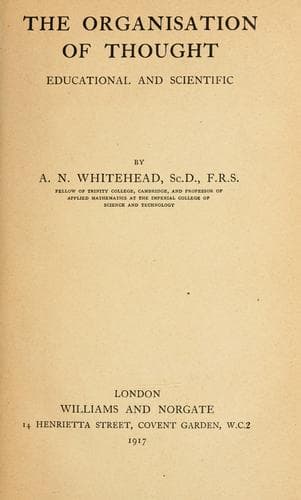
The organisation of thought, educational and scientificWhitehead, Alfred North
Philosophy
The organisation of thought, educational and scientific
Whitehead, Alfred North
Education
In estimating the importance of technical education we must rise above
the exclusive association of learning with book-learning. First-hand
knowledge is the ultimate basis of intellectual life. To a large
extent book-learning conveys second-hand information, and as such can
never rise to the importance of immediate practice. Our goal is to see
the immediate event of our lives as instances of our general ideas.
What the learned world tends to offer is one second-hand scrap of
information illustrating ideas derived from another second-hand scrap
of information. The second-handedness of the learned world is the
secret of its mediocrity. It is tame because it has never been scared
by facts. The main importance of Francis Bacon's influence does not
lie in any peculiar theory of inductive reasoning which he happened to
express, but in the revolt against second-hand information of which he
was a leader.
The peculiar merit of a scientific education should be, that it bases
thought upon first-hand observation; and the corresponding merit of a
technical education is, that it follows our deep natural instinct to
translate thought into manual skill, and manual activity into thought.
We are a Mathematical Association, and it is natural to ask: Where do
we come in? We come in just at this point.
The thought which science evokes is logical thought. Now logic is of
two kinds: the logic of discovery and the logic of the discovered.
The logic of discovery consists in the weighing of probabilities, in
discarding details deemed to be irrelevant, in divining the general
rules according to which events occur, and in testing hypotheses by
devising suitable experiments. This is inductive logic.
The logic of the discovered is the deduction of the special events
which, under certain circumstances, would happen in obedience to the
assumed laws of nature. Thus when the laws are discovered or assumed,
their utilisation entirely depends on deductive logic. Without
deductive logic science would be entirely useless. It is merely a
barren game to ascend from the particular to the general, unless
afterwards we can reverse the process and descend from the general to
the particular, ascending and descending like the angels on Jacob's
ladder. When Newton had divined the law of gravitation he at once
proceeded to calculate the earth's attractions on an apple at its
surface and on the moon. We may note in passing that inductive logic
would be impossible without deductive logic. Thus Newton's calculations
were an essential step in his inductive verification of the great law.
Now mathematics is nothing else than the more complicated parts of
the art of deductive reasoning, especially where it concerns number,
quantity, and space.
Public-domain text, read in full here on John Shaqi.
Reviews
Reviews
No reviews yet
Be the first to share your thoughts on this work.
Join the Discussion
Join the discussion
Sign in to leave a comment or review.
Sign InorCreate an account