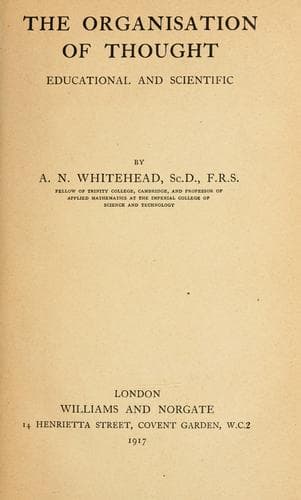
The organisation of thought, educational and scientificWhitehead, Alfred North
Philosophy
The organisation of thought, educational and scientific
Whitehead, Alfred North
Education
Now there are two kinds of intellectual enjoyment: the enjoyment of
creation, and the enjoyment of relaxation. They are not necessarily
separated. A change of occupation may give the full tide of happiness
which comes from the concurrence of both forms of pleasure. The
appreciation of literature is really creation. The written word, its
music, and its associations, are only the stimuli. The vision which
they evoke is our own doing. No one, no genius other than our own,
can make our own life live. But except for those engaged in literary
occupations, literature is also a relaxation. It gives exercise to that
other side which any occupation must suppress during the working hours.
Art also has the same function in life as has literature.
To obtain the pleasure of relaxation requires no help. The pleasure
is merely to cease doing. Some such pure relaxation is a necessary
condition of health. Its dangers are notorious, and to the greater
part of the necessary relaxation nature has affixed, not enjoyment,
but the oblivion of sleep. Creative enjoyment is the outcome of
successful effort and requires help for its initiation. Such enjoyment
is necessary for high-speed work and for original achievement.
To speed up production with unrefreshed workmen is a disastrous
economic policy. Temporary success will be at the expense of the
nation, which, for long years of their lives, will have to support
worn-out artisans--unemployables. Equally disastrous is the
alternation of spasms of effort with periods of pure relaxation.
Such periods are the seed-times of degeneration, unless rigorously
curtailed. The normal recreation should be change of activity,
satisfying the cravings of instincts. Games afford such activity. Their
disconnection emphasises the relaxation, but their excess leaves us
empty.
It is here that literature and art should play an essential part in
a healthily organised nation. Their services to economic production
would be only second to those of sleep or of food. I am not now talking
of the training of an artist, but of the use of art as a condition of
healthy life. It is analogous to sunshine in the physical world.
When we have once rid our minds of the idea that knowledge is to
be exacted, there is no especial difficulty or expense involved in
helping the growth of artistic enjoyment. All school-children could
be sent at regular intervals to neighbouring theatres where suitable
plays could be subsidised. Similarly for concerts and cinema films.
Pictures are more doubtful in their popular attraction; but interesting
representations of scenes or ideas which the children have read about
would probably appeal. The pupils themselves should be encouraged
in artistic efforts. Above all the art of reading aloud should be
cultivated. The Roger de Coverley essays of Addison are perfect
examples of readable prose.
Public-domain text, read in full here on John Shaqi.
Reviews
Reviews
No reviews yet
Be the first to share your thoughts on this work.
Join the Discussion
Join the discussion
Sign in to leave a comment or review.
Sign InorCreate an account