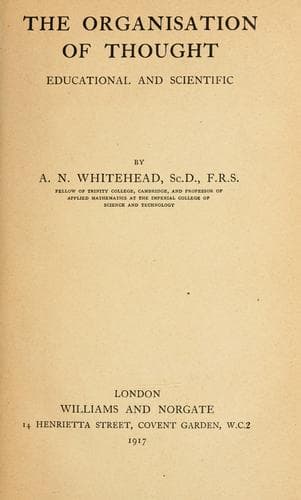
The organisation of thought, educational and scientificWhitehead, Alfred North
Philosophy
The organisation of thought, educational and scientific
Whitehead, Alfred North
Education
It is impossible, even in brief outline, to explain how mathematics
is developed from the concepts of class and correlation, including
many-cornered correlations, which are established in the third section.
I can only allude to the headings of the process, which is fully
developed in the work, _Principia Mathematica_, by Mr. Russell
and myself. There are in this process of development seven special
sorts of correlations which are of peculiar interest. The first sort
comprises one-to-many, many-to-one, and one-to-one correlations.
The second sort comprises serial relations, that is, correlations
by which the members of some field are arranged in serial order, so
that, in the sense defined by the relation, any member of the field
is either before or after any other member. The third class comprises
inductive relations, that is, correlations on which the theory of
mathematical induction depends. The fourth class comprises selective
relations, which are required for the general theory of arithmetic
operations, and elsewhere. It is in connection with such relations that
the famous multiplicative axiom arises for consideration. The fifth
class comprises vector relations, from which the theory of quantity
arises. The sixth class comprises ratio relations, which interconnect
number and quantity. The seventh class comprises three-cornered and
four-cornered relations which occur in geometry.
A bare enumeration of technical names, such as the above, is not very
illuminating, though it may help to a comprehension of the demarcations
of the subject. Please remember that the names are technical names,
meant, no doubt, to be suggestive, but used in strictly defined
senses. We have suffered much from critics who consider it sufficient
to criticise our procedure on the slender basis of a knowledge of
the dictionary meanings of such terms. For example, a one-to-one
correlation depends on the notion of a class with only one member, and
this notion is defined without appeal to the concept of the number one.
The notion of diversity is all that is wanted. Thus the class α has
only one member, if (1) the class of values of _x_ which satisfies
the propositional function,
_x_ is not a member of α,
is not the whole type of relevant values of _x_, and if (2) the
propositional function,
_x_ and _y_ are members of α, and _x_ is diverse from
_y_
is false, whatever be the values of _x_ and _y_ in the
relevant type.
Public-domain text, read in full here on John Shaqi.
Reviews
Reviews
No reviews yet
Be the first to share your thoughts on this work.
Elsewhere in the archive
Join the Discussion
Join the discussion
Sign in to leave a comment or review.
Sign InorCreate an account