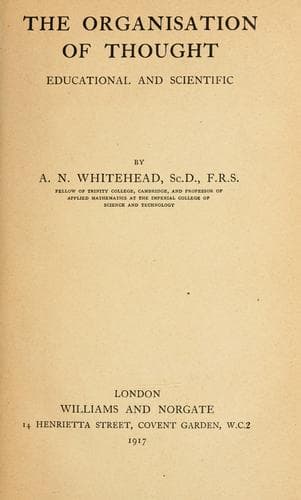
The organisation of thought, educational and scientificWhitehead, Alfred North
Philosophy
The organisation of thought, educational and scientific
Whitehead, Alfred North
Education
Among the most easily analysed of such relations are the space
relations. Again the red object is in immediate perception nothing else
than a red object. It is better termed an "object of redness." Thus a
better approximation to an immediate perceptive judgment is, "Hullo,
object of redness there!" But, of course, in this formulation other
more complex relations are omitted.
This tendency towards a false simplicity in scientific analysis, to
an excessive abstraction, to an over-universalising of universals,
is derived from the earlier metaphysical stage. It arises from the
implicit belief that we are endeavouring to qualify the real with
appropriate adjectives. In conformity with this tendency we think,
"this real thing is red." Whereas our true goal is to make explicit
our perception of the apparent in terms of its relations. What we
perceive is redness related to other apparents. Our object is the
analysis of the relations.
One aim of science is the harmony of thought, that is, to secure
that judgments which are logical contraries should not be
thought-expressions of consciousness. Another aim is the extension of
such harmonised thought.
Some thoughts arise directly from sense-presentation, and are part of
the state of consciousness which is perception. Such a thought is, "An
object of redness is there." But in general the thought is not verbal,
but is a direct apprehension of qualities and relations within the
content of consciousness.
Amid such thoughts there can be no lack of harmony. For direct
apprehension is in its essence unique, and it is impossible to
apprehend an object as both red and blue. Subsequently it may be judged
that if other elements of the consciousness had been different, the
apprehension would have been of a blue object. Then--under certain
circumstances--the original apprehension will be called an error. But
for all that the fact remains, there was an apprehension of a red
object.
When we speak of sense-presentation, we mean these primary thoughts
essentially involved in its perception. But there are thoughts about
thoughts, and thoughts derived from other thoughts. These are secondary
thoughts. At this point it is well explicitly to discriminate between
an actual thought-expression, namely, a judgment actually made, and a
mere proposition which is a hypothetical thought-expression, namely,
an imagined possibility of thought-expression. Note that the actual
complete thought-content of the consciousness is explicitly neither
affirmed or denied. It is just what _is_ thought. Thus, to think
"two and two make four" is distinct from affirming that two and two
make four. In the first case the proposition is the thought-expression,
in the second case the affirmation of the proposition is the
thought-expression, and the proposition has been degraded to a mere
proposition, namely, to a hypothetical thought-expression which is
reflected upon.
Public-domain text, read in full here on John Shaqi.
Reviews
Reviews
No reviews yet
Be the first to share your thoughts on this work.
Elsewhere in the archive
Join the Discussion
Join the discussion
Sign in to leave a comment or review.
Sign InorCreate an account