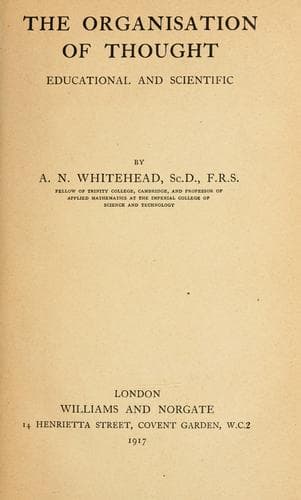
The organisation of thought, educational and scientificWhitehead, Alfred North
Philosophy
The organisation of thought, educational and scientific
Whitehead, Alfred North
Education
A distinction is sometimes made between facts and thoughts. So far as
physical science is concerned, the facts are thoughts, and thoughts
are facts. Namely, the facts of sense-presentation as they affect
science are those elements in the immediate apprehensions which are
thoughts. Also, actual thought-expressions, primary or secondary, are
the material facts which science interprets.
The distinction that facts are given, but thoughts are free, is
not absolute. We can select and modify our sense-presentation, so
that facts--in the narrower sense of immediate apprehension of
sense-presentation--are to some degree subject to volition. Again, our
stream of thought-expression is only partially modified by explicit
volition. We can choose our physical experience, and we find ourselves
thinking; namely, on the one hand there is selection amid the dominant
necessity of sense, and on the other hand, the thought-content of
consciousness (so far as secondary thoughts are concerned) is not
wholly constituted by the selection of will.
Thus, on the whole there is a large primary region of secondary
thought, as well as of the primary thoughts of sense-presentation,
which is given in type. That is the way in which we do think of things,
not wholly from any abstract necessity, so far as we know, but because
we have inherited the method from an environment. It is the way we find
ourselves thinking, a way which can only be fundamentally laid aside by
an immense effort, and then only for isolated short periods of time.
This is what I have called the "whole apparatus of commonsense thought."
It is this body of thought which is assumed in science. It is a way
of thinking rather than a set of axioms. It is, in fact, the set of
concepts which commonsense has found useful in sorting out human
experience. It is modified in detail, but assumed in gross. The
explanations of science are directed to finding conceptions and
propositions concerning nature which explain the importance of these
common sense notions. For example, a chair is a common sense notion,
molecules and electrons explain our vision of chairs.
Now science aims at harmonising our reflective and derivative thoughts
with the primary thoughts involved in the immediate apprehension of
sense-presentation. It also aims at producing such derivative thoughts,
logically knit together. This is scientific theory; and the harmony to
be achieved is the agreement of theory with observation, which is the
apprehension of sense-presentation.
Thus there is a twofold scientific aim: (1) the production of theory
which agrees with experience; and (2) the explanation of commonsense
concepts of nature, at least in their main outlines. This explanation
consists in the preservation of the concepts in a scientific theory of
harmonised thought.
Public-domain text, read in full here on John Shaqi.
Reviews
Reviews
No reviews yet
Be the first to share your thoughts on this work.
Elsewhere in the archive
Join the Discussion
Join the discussion
Sign in to leave a comment or review.
Sign InorCreate an account