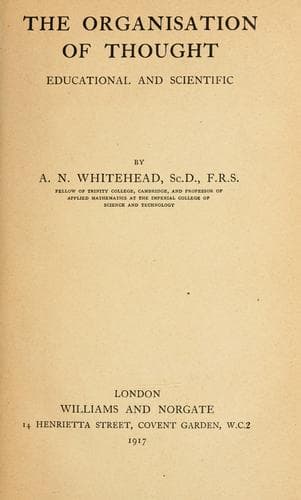
The organisation of thought, educational and scientificWhitehead, Alfred North
Philosophy
The organisation of thought, educational and scientific
Whitehead, Alfred North
Education
It is not asserted that this is what scientists in the past meant to
achieve, or thought that they could achieve. It is suggested as the
actual result of scientific effort, so far as that effort has had
any measure of success. In short, we are here discussing the natural
history of ideas and not volitions of scientists.
_II. Objects_
We perceive things in space. For example, among such things are dogs,
chairs, curtains, drops of water, gusts of air, flames, rainbows,
chimes of bells, odours, aches and pains. There is a scientific
explanation of the origin of these perceptions. This explanation
is given in terms of molecules, atoms, electrons, and their mutual
relations, in particular of their space-relations, and waves of
disturbance of these space-relations which are propagated through
space. The primary elements of the scientific explanation--molecules,
etc.--are not the things directly perceived. For example, we do not
perceive a wave of light; the sensation of sight is the resultant
effect of the impact of millions of such waves through a stretch of
time. Thus the object directly perceived corresponds to a series of
events in the physical world, events which are prolonged through
a stretch of time. Nor is it true that a perceived object always
corresponds to the same group of molecules. After a few years we
recognise the same cat, but we are thereby related to different
molecules.
Again, neglecting for a moment the scientific explanation, the
perceived object is largely the supposition of our imagination. When
we recognised the cat, we also recognised that it was glad to see
us. But we merely heard its mewing, saw it arch its back, and felt it
rubbing itself against us. We must distinguish, therefore, between the
many direct objects of sense, and the single indirect object of thought
which is the cat.
Thus, when we say that we perceived the cat and understood its
feelings, we mean that we heard a sense-object of sound, that we saw a
sense-object of sight, that we felt a sense-object of touch, and that
we thought of a cat and imagined its feelings.
Public-domain text, read in full here on John Shaqi.
Reviews
Reviews
No reviews yet
Be the first to share your thoughts on this work.
Elsewhere in the archive
Join the Discussion
Join the discussion
Sign in to leave a comment or review.
Sign InorCreate an account