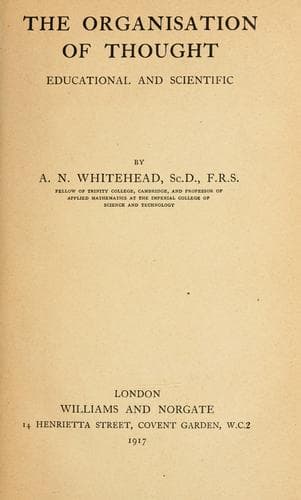
The organisation of thought, educational and scientificWhitehead, Alfred North
Philosophy
The organisation of thought, educational and scientific
Whitehead, Alfred North
Education
Sense-objects are correlated by time-relations and space-relations.
Three simultaneous sense-objects which are also spatially coincident,
are combined by thought into the perception of one cat. Such
combination of sense-objects is an instinctive immediate judgment in
general without effort of reasoning. Sometimes only one sense-object
is present. For example, we hear mewing and say there must be a cat
in the room. The transition from the sense-object to the cat has
then been made, by deliberate ratiocination. Even the concurrence of
sense-objects may provoke such a self-conscious effort. For example, in
the dark we feel something, and hear mewing from the same place, and
think, Surely this is a cat. Sight is more bold; when we see a cat, we
do not think further. We identify the sight with the cat, whereas the
cat and the mew are separate. But such immediate identification of
a sight object and an object of thought may lead to error; the birds
pecked at the grapes of Apelles.
A single sense-object is a complex entity. The sight-object of a
tile on the hearth may remain unchanged as we watch it in a steady
light, remaining ourselves unchanged in position. Even then it is
prolonged in time, and has parts in space. Also it is somewhat
arbitrarily distinguished from a larger whole of which it forms part.
But the glancing fire-light and a change in our position alters the
sight-object. We judge that the tile thought-object remains unchanged.
The sight-object of the coal on the fire gradually modifies, though
within short intervals it remains unchanged. We judge that the coal
thought-object is changing. The flame is never the same, and its shape
is only vaguely distinguishable.
We conclude that a single self-identical sight-object is already a
phantasy of thought. Consider the unchanging sight-object of the tile,
as we remain still in a steady light. Now a sense-object perceived at
one time is a distinct object from a sense-object seen at another time.
Thus the sight of the tile at noon is distinct from its sight at 12.30.
But there is no such thing as a sense-object at an instant. As we stare
at the tile, a minute, or a second, or a tenth of a second, has flown
by: essentially there is a duration. There is a stream of sight, and
we can distinguish its parts. But the parts also are streams, and
it is only in thought that the stream separates into a succession of
elements. The stream may be "steady" as in the case of the unchanging
sight-tile, or may be "turbulent" as in the case of the glancing
sight-flame. In either case a sight-object is some arbitrarily small
part of the stream.
Again, the stream which forms the succession of sight-tiles is merely a
distinguishable part of the whole stream of sight-presentation.
Public-domain text, read in full here on John Shaqi.
Reviews
Reviews
No reviews yet
Be the first to share your thoughts on this work.
Elsewhere in the archive
Join the Discussion
Join the discussion
Sign in to leave a comment or review.
Sign InorCreate an account