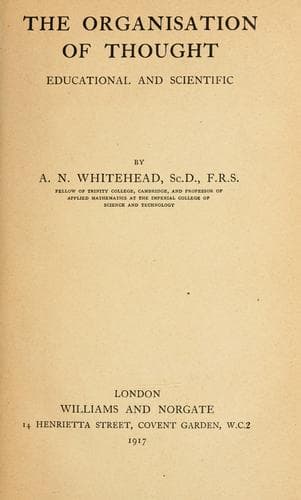
The organisation of thought, educational and scientificWhitehead, Alfred North
Philosophy
The organisation of thought, educational and scientific
Whitehead, Alfred North
Education
The thought-object of perception is, in fact, a device to make plain
to our reflective consciousness relations which hold within the
complete stream of sense-presentation. Concerning the utility of this
weapon there can be no question; it is the rock upon which the whole
structure of commonsense thought is erected. But when we consider the
limits of its application the evidence is confused. A great part of our
sense-presentation can be construed as perception of various persistent
thought-objects. But hardly at any time can the sense-presentations
be construed wholly in that way. Sights lend themselves easily to
this construction, but sight can be baffled: for example, consider
reflections in looking-glasses, apparently bent sticks half in and half
out of water, rainbows, brilliant patches of light which conceal the
object from which they emanate, and many analogous phenomena. Sound
is more difficult; it tends largely to disengage itself from any such
object. For example, we see the bell, but we hear the sound which
comes from the bell; yet we also say that we hear the bell. Again, a
toothache is largely by itself, and is only indirectly a perception
of the nerve of the tooth. Illustrations to the same effect can be
accumulated from every type of sensation.
Another difficulty arises from the fact of change. The thought-object
is conceived as one thing, wholly actual at each instant. But since
the meat has been bought it has been cooked, the grass grows and then
withers, the coal burns in the fire, the pyramids of Egypt remain
unchanged for ages, but even the pyramids are not wholly unchanged. The
difficulty of change is merely evaded by affixing a technical Latin
name to a supposed logical fallacy. A slight cooking leaves the meat
the same object, but two days in the oven burns it to a cinder. When
does the meat cease to be? Now the chief use of the thought-object
is the concept of it as one thing, here and now, which later can be
recognised, there and then. This concept applies sufficiently well to
most things for short times, and to many things for long times. But
sense-presentation as a whole entirely refuses to be patient of the
concept.
We have now come to the reflective region of explanation, which is
science.
Public-domain text, read in full here on John Shaqi.
Reviews
Reviews
No reviews yet
Be the first to share your thoughts on this work.
Elsewhere in the archive
Join the Discussion
Join the discussion
Sign in to leave a comment or review.
Sign InorCreate an account