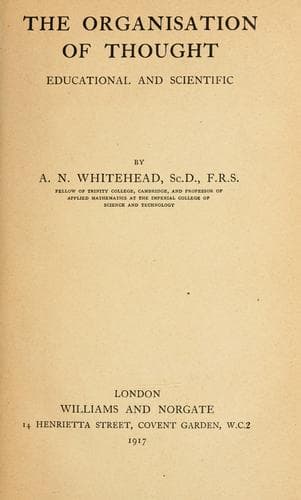
The organisation of thought, educational and scientificWhitehead, Alfred North
Philosophy
The organisation of thought, educational and scientific
Whitehead, Alfred North
Education
A great part of the difficulty is at once removed by applying the
principle of convergence to simplicity. We habitually make our
thought-objects too large; we should think in smaller parts. For
example, the Sphinx has changed by its nose becoming chipped, but by
proper inquiry we could find the missing part in some private house
of Western Europe or Northern America. Thus, either part, the rest
of the Sphinx or the chip, regains its permanence. Furthermore, we
enlarge this explanation by conceiving parts so small that they can
only be observed under the most favourable circumstances. This is a
wide extension of the principle of convergence in its application to
nature; but it is a principle amply supported by the history of exact
observation.
Thus, change in thought-objects of perception is largely explained as
a disintegration into smaller parts, themselves thought-objects of
perception. The thought-objects of perception which are presupposed in
the common thought of civilised beings are almost wholly hypothetical.
The material universe is largely a concept of the imagination which
rests on a slender basis of direct sense-presentation. But none the
less it is a fact; for it is a fact that actually we imagine it. Thus
it is actual in our consciousness just as sense-presentation also is
actual there. The effort of reflective criticism is to make these two
factors in our consciousness agree where they are related, namely,
to construe our sense-presentation as actual realisation of the
hypothetical thought-objects of perception.
The wholesale employment of purely hypothetical thought-objects of
perception enables science to explain some of the stray sense-objects
which cannot be construed as perceptions of a thought-object of
perception: for example, sounds. But the phenomena as a whole defy
explanation on these lines until a further fundamental step is taken,
which transforms the whole concept of the material universe. Namely,
the thought-object of perception is superseded by the thought-object of
science.
The thought-objects of science are molecules, atoms, and electrons. The
peculiarity of these objects is that they have shed all the qualities
which are capable of direct sense-representation in consciousness.
They are known to us only by their associated phenomena, namely,
series of events in which they are implicated are represented in our
consciousness by sense-presentations. In this way, the thought-objects
of science are conceived as the causes of sense-representation. The
transition from thought-objects of perception to thought-objects of
science is decently veiled by an elaborate theory concerning primary
and secondary qualities of bodies.
Public-domain text, read in full here on John Shaqi.
Reviews
Reviews
No reviews yet
Be the first to share your thoughts on this work.
Elsewhere in the archive
Join the Discussion
Join the discussion
Sign in to leave a comment or review.
Sign InorCreate an account