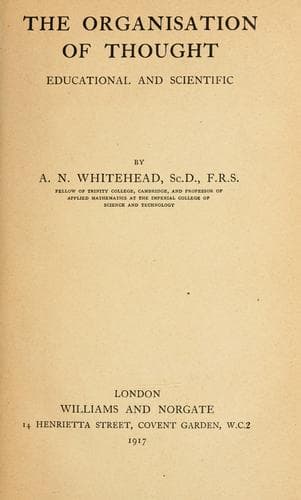
The organisation of thought, educational and scientificWhitehead, Alfred North
Philosophy
The organisation of thought, educational and scientific
Whitehead, Alfred North
Education
It is possible, however, that some mode of conceiving the
whole-and-part relation between extended objects as the all-and-some
relation of logical classes can be found. But in this case the
extended objects as here conceived cannot be the true sense-objects
which are present to consciousness. For as here conceived a part of a
sense-object is another sense-object of the same type; and therefore
one sense-object cannot be a class of other sense-objects, just as
a tea-spoon cannot be a class of other tea-spoons. The ordinary way
in thought by which whole-and-part is reduced to all-and-some is by
the device of points, namely, the part of an object occupies some
of the points occupied by the whole object. If any one holds that
in his consciousness the sense-presentation is a presentation of
point-objects, and that an extended object is merely a class of such
point-objects collected together in thought, then this ordinary method
is completely satisfactory. We shall proceed on the assumption that
this conception of directly perceived point-objects has no relation to
the facts.
In the preceding address on "The Organisation of Thought," another mode
is suggested. But this method would apply only to the thought-object
of perception, and has no reference to the primary sense-objects here
considered. Accordingly it must reckon as a subordinate device for a
later stage of thought.
Thus the point-object in time and the point-object in space, and the
double point-object both in time and space, must be conceived as
intellectual constructions. The fundamental fact is the sense-object,
extended both in time and space, with the fundamental relation of
whole-to-part to other such objects, and subject to the law of
convergence to simplicity as we proceed in thought through a series of
successively contained parts.
The relation whole-to-part is a temporal or spatial relation, and
is therefore primarily a relation holding between sense-objects of
perception, and it is only derivatively ascribed to the thought-objects
of perception of which they are components. More generally, space and
time relations hold primarily between sense-objects of perception and
derivatively between thought-objects of perception.
_Definition of Points._--The genesis of points of time and of
space can now be studied. We must distinguish (1) sense-time and
sense-space, and (2) thought-time of perception and thought-space of
perception.
Sense-time and sense-space are the actually observed time-relations
and space-relations between sense-objects. Sense-time and sense-space
have no points except, perhaps, a few sparse instances, sufficient
to suggest the logical idea; also, sense-time and sense-space are
discontinuous and fragmentary.
Public-domain text, read in full here on John Shaqi.
Reviews
Reviews
No reviews yet
Be the first to share your thoughts on this work.
Elsewhere in the archive
Join the Discussion
Join the discussion
Sign in to leave a comment or review.
Sign InorCreate an account