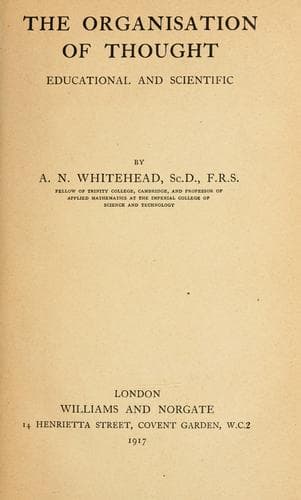
The organisation of thought, educational and scientificWhitehead, Alfred North
Philosophy
The organisation of thought, educational and scientific
Whitehead, Alfred North
Education
Thought-time of perception and thought-space of perception are the time
and space relations which hold between thought-objects of perception.
Thought-time of perception and thought-space of perception are each
continuous. By "continuous" is here meant that all thought-objects of
perception have to each other a time (or space) relation.
The origin of points is the effort to take full advantage of
the principle of convergence to simplicity. In so far as this
principle does not apply, a point is merely a cumbrous way of
directing attention to a set of relations between a certain set of
thought-objects of perception, which set of relations, though actual so
far as a thought-object is actual, is (under this supposition) of no
particular importance. Thus the proved importance in physical science
of the concepts of points in time and points in space is a tribute to
the wide applicability of this principle of convergence.
Euclid defines a point as without parts and without magnitude. In
modern language a point is often described as an ideal limit by
indefinitely continuing the process of diminishing a volume (or
area). Points as thus conceived are often called convenient fictions.
This language is ambiguous. What is meant by a fiction? If it means
a conception which does not correspond to any fact, there is some
difficulty in understanding how it can be of any use in physical
science. For example, the fiction of a red man in a green coat
inhabiting the moon can never be of the slightest scientific service,
simply because--as we may presume--it corresponds to no fact. By
calling the concept of points a convenient fiction, it must be meant
that the concept does correspond to some important facts. It is, then,
requisite, in the place of such vague allusiveness, to explain exactly
what are the facts to which the concept corresponds.
We are not much helped by explaining that a point is an ideal limit.
What is a limit? The idea of a limit has a precise meaning in the
theory of series, and in the theory of the values of functions; but
neither of these meanings apply here. It may be observed that, before
the ordinary mathematical meanings of limit had received a precise
explanation, the idea of a point as a limit might be considered as
one among other examples of an idea only to be apprehended by direct
intuition. This view is not now open to us. Thus, again, we are
confronted with the question: What are the precise properties meant
when a point is described as an ideal limit? The discussion which now
follows is an attempt to express the concept of a point in terms of
thought-objects of perception related together by the whole-and-part
relation, considered either as a time-relation or as a space-relation.
If it is so preferred, it may be considered that the discussion is
directed towards a precise elucidation of the term "ideal limit" as
often used in this connection.
Public-domain text, read in full here on John Shaqi.
Reviews
Reviews
No reviews yet
Be the first to share your thoughts on this work.
Elsewhere in the archive
Join the Discussion
Join the discussion
Sign in to leave a comment or review.
Sign InorCreate an account