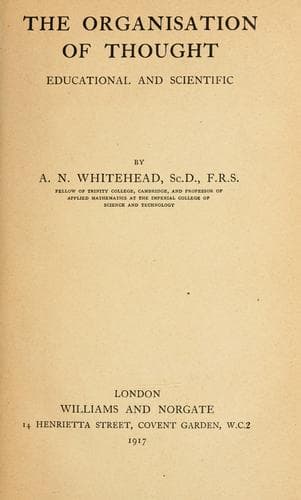
The organisation of thought, educational and scientificWhitehead, Alfred North
Philosophy
The organisation of thought, educational and scientific
Whitehead, Alfred North
Education
Commonsense thought also supports this refusal to conceive of all
space as essentially depending on hypothetical objects which fill it.
We think of material objects as filling space, but we ask whether any
objects exist between the Earth and the Sun, between the stars, or
beyond the stars. For us, space is there; the only question is whether
or not it be full. But this form of question presupposes the meaning of
empty space, namely, of space not containing hypothetical objects.
This brings up a wider use of the concept of points, necessitating
a wider definition. Hitherto we have conceived points as indicating
relations of enclosure between objects. We thus arrive at what now
we will term "material points." But the idea of points can now be
transformed so as to indicate the possibilities of external relations
not those of enclosure. This is effected by an enlargement of the
concept of ideal points, already known to geometers.
Define "material lines" to be complete collinear classes of collinear
points. Consider now the set of material lines which contain a certain
material point. Call such a set of lines an ideal point. This set of
lines indicates a possibility of position, which is in fact occupied
by that material point common to all the material lines. So this ideal
point is an occupied ideal point. Now consider a set of three material
lines, such that any two are coplanar, but not the whole three, and
further consider the complete set of material lines such that each is
coplanar with each of the three material lines first chosen. The axioms
which hold for the material lines will enable us to prove that any two
lines of this set are coplanar. Then the whole set of lines, including
the three original lines, forms an ideal point, according to the
definition in its full generality. Such an ideal point may be occupied.
In that case there is a material point common to all the lines of the
set, but it may be unoccupied. Then the ideal point merely indicates
a possibility of spatial relations which has not been realised. It is
the point of empty space. Thus the ideal points, which may or may not
be occupied, are the points of geometry viewed as an applied science.
These points are distributed into straight lines and planes. But any
further discussion of this question will lead us into the technical
subject of the axioms of geometry and their immediate consequences.
Enough has been said to show how geometry arises according to the
relational theory of space.
Space as thus conceived is the thought-space of the material world.
_IV. Fields of Force_
The thought-objects of science are conceived as directly related to
this thought-space. Their spatial relations are among those indicated
by the points of the thought-space. Their emergence in science has
been merely a further development of processes already inherent in
commonsense thought.
Public-domain text, read in full here on John Shaqi.
Reviews
Reviews
No reviews yet
Be the first to share your thoughts on this work.
Elsewhere in the archive
Join the Discussion
Join the discussion
Sign in to leave a comment or review.
Sign InorCreate an account