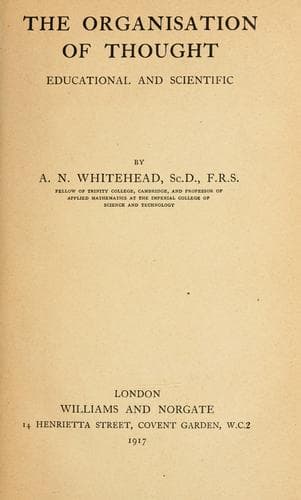
The organisation of thought, educational and scientificWhitehead, Alfred North
Philosophy
The organisation of thought, educational and scientific
Whitehead, Alfred North
Education
Relations within the complete sense-presentation were represented
in thought by the concept of thought-objects of perception. All
sense-presentation could not be represented in this way; also the
change and disappearance of thought-objects occasioned confusion
of thought. A reduction to order of this confusion was attempted
by the concepts of permanent matter with primary and secondary
qualities. Finally, this has issued in the secondary qualities being
traced as perception of events generated by the objects, but--as
perceived--entirely disconnected with them. Also the thought-objects
of perception have been replaced by molecules and electrons and
ether-waves, until at length it is never the thought-object of science
which is perceived, but complicated series of events in which they are
implicated. If science be right, nobody ever perceived a thing, but
only an event. The result is, that the older language of philosophy
which still survives in many quarters is now thoroughly confusing
when brought into connection with the modern concepts of science.
Philosophy--that is, the older philosophy--conceives the thing as
directly perceived. According to scientific thought, the ultimate thing
is never perceived, perception essentially issuing from a series of
events. It is impossible to reconcile the two points of view.
The advantage of the modern scientific concept is that it is enabled
to "explain" the fluid vague outlines of sense-presentation. The
thought-object of perception is now conceived as a fairly stable
state of motion of a huge group of molecules, constantly changing,
but preserving a certain identity of characteristics. Also stray
sense-objects, not immediately given as part of a thought-object of
perception, are now explicable: the dancing light-reflection, the
vaguely heard sound, the smell. In fact, the perceived events of
the scientific world have the same general definition and lack of
definition, and the same general stability and lack of stability,
as the sense-objects of the complete sense-presentation or as the
thought-objects of perception.
The thought-objects of science, namely, molecules, atoms, and
electrons, have gained in permanence. The events are reduced to changes
in space-configuration. The laws determining these changes are the
ultimate laws of nature.
The laws of change in the physical universe proceed on the assumption
that the preceding states of the universe determine the character of
the change. Thus, to know the configurations and events of the universe
up to and including any instant would involve sufficient data from
which to determine the succession of events throughout all time.
Public-domain text, read in full here on John Shaqi.
Reviews
Reviews
No reviews yet
Be the first to share your thoughts on this work.
Elsewhere in the archive
Join the Discussion
Join the discussion
Sign in to leave a comment or review.
Sign InorCreate an account