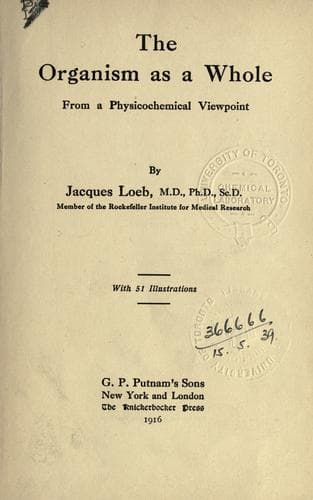
The Organism as a Whole, from a Physicochemical Viewpoint — John Shaqi
The Organism as a Whole, from a Physicochemical ViewpointLoeb, Jacques
Science
The Organism as a Whole, from a Physicochemical Viewpoint
Loeb, Jacques
Biology; Life (Biology); Mendel's law
4. The influence of the whole on the parts is nowhere shown more
strikingly than in the field of regeneration. It is known that pieces
cut from the plant or animal may give rise to new growth which in many
cases will restore somewhat the original organism. Instead of asking
what is the cause of this so-called regeneration we may ask, why the
same pieces do not regenerate as long as they are parts of the whole.
In this form the mysterious influence of the whole over its parts
is put into the foreground. We shall see that growth takes place in
certain cells when certain substances in the circulation can collect
there. The mysterious influence of the whole on these parts consists
often merely of the fact that the circulating specific or non-specific
substances--we cannot yet decide which--will in the whole be attracted
by certain spots and that this will prevent them from acting on other
parts of the organism. If such parts are isolated the substances can
no longer flow away from these parts and the parts will begin to grow.
It thus becomes utterly unnecessary to endow such organisms with a
“directing force” which has to elaborate the isolated parts into a
whole.
5. The same difficulty which we have discussed in regard to
morphogenesis exists also in connection with those instincts which
preserve the life of the organism and of the race. The reader need
only be reminded of all the complicated instincts of mating by which
sperm and eggs are brought together; or those by which the young
are prevented from starvation to realize the apparently desperate
problems in store for a mechanist, to whom the assumption of design
is meaningless. And yet we are better off in regard to our knowledge
of the instincts than we are in regard to morphogenesis, as in the
former we can show that the apparent instincts in some cases obey
simple physicochemical laws with almost mathematical accuracy. Since
the validity of the law of gravitation has been proved for the solar
system the idea of design in the motion of the planets has lost its
usefulness, and this fact must serve us as a guide wherever we attempt
to put science beyond the possibility of mysticism. As soon as we
can show that a life phenomenon obeys a simple physical law there is
no longer any need for assuming the action of non-physical agencies.
We shall see that this has been accomplished for one group of animal
instincts; namely those which determine the relation of animals to
light, since these are being gradually reduced to the law of Bunsen and
Roscoe. This law states that the chemical effect of light equals the
product of intensity into duration of illumination. Some authors object
to the tendency toward reducing everything in biology to mathematical
laws or figures; but where would the theory of heredity be without
figures? Figures have been responsible for showing that the laws of
chance and not of design rule in heredity. Biology will be scientific
Public-domain text, read in full here on John Shaqi.
Reviews
Reviews
No reviews yet
Be the first to share your thoughts on this work.
Join the Discussion
Join the discussion
Sign in to leave a comment or review.
Sign InorCreate an account