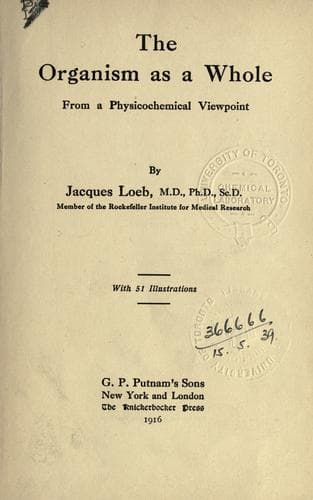
The Organism as a Whole, from a Physicochemical Viewpoint — John Shaqi
The Organism as a Whole, from a Physicochemical ViewpointLoeb, Jacques
Science
The Organism as a Whole, from a Physicochemical Viewpoint
Loeb, Jacques
Biology; Life (Biology); Mendel's law
only to the extent that it succeeds in reducing life phenomena to
quantitative laws.
Those familiar with the theories of evolution know the extensive
rôle ascribed to the adaptations of organisms. The writer in
1889 called attention to the fact that reactions to light--_e.
g._, positive heliotropism--are found in organisms that never
by any chance make use of them; and later that a great many
organisms show definite instinctive reactions towards a galvanic
current--galvanotropism--although no organism has ever had or
ever will have a chance to be exposed to such a current except in
laboratory experiments. This throws a different light upon the
seemingly purposeful character of animal reactions. Heliotropism
depends primarily upon the presence of photosensitive substances
in the eye or the epidermis of the organism, and these substances
are inherited regardless of whether they are useful or not. It is
only a metaphor to call reactions resulting from the presence of
photosensitive substances “adaptation.” In this book other examples
are given which show that authors have too often spoken of adaptation
to environment where the environment was not responsible for the
phenomena. The blindness of cave animals and the resistance of certain
marine animals to higher concentrations of sea water are such cases.
Cuénot speaks of “preadaptation” to express this relation. The fact
is that the “adaptations” often existed before the animal was exposed
to surroundings where they were of use. This relieves us also of the
necessity of postulating the existence of the inheritance of acquired
characters, although it is quite possible that the future may furnish
proof that such a mode of inheritance exists.
6. We have mentioned that according to Claude Bernard two groups of
phenomena occur in the living organism: (1) the phenomena of vital
creation or organizing synthesis (especially in the egg and during
development); (2) the phenomena of death or organic destruction. These
two processes are briefly discussed in the first and last chapters.
These introductory remarks may perhaps make it easier for the reader to
retain the thread of the main ideas in the details of experiments and
tables given in this book.
CHAPTER II
THE SPECIFIC DIFFERENCE BETWEEN LIVING AND DEAD MATTER
AND THE QUESTION OF THE ORIGIN OF LIFE
Public-domain text, read in full here on John Shaqi.
Reviews
Reviews
No reviews yet
Be the first to share your thoughts on this work.
Join the Discussion
Join the discussion
Sign in to leave a comment or review.
Sign InorCreate an account