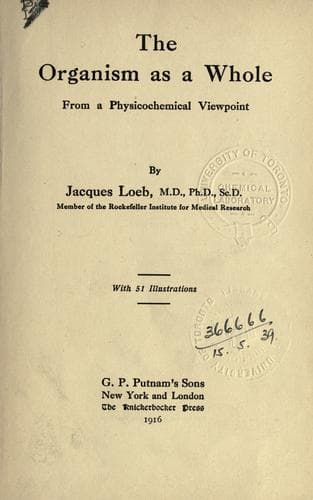
The Organism as a Whole, from a Physicochemical Viewpoint — John Shaqi
The Organism as a Whole, from a Physicochemical ViewpointLoeb, Jacques
Science
The Organism as a Whole, from a Physicochemical Viewpoint
Loeb, Jacques
Biology; Life (Biology); Mendel's law
While the hydrolytic action of enzymes is thus clear the synthesis
in the cell is still a riddle. An interesting suggestion was made by
van’t Hoff, who in 1898 expressed the idea that the hydrolytic enzymes
should also act in the opposite direction, namely synthetically.
Thus it should not only be possible to digest proteins with pepsin
but also to synthetize them from the products of digestion with the
aid of the same enzyme. This expectation was based on the idea that
the enzyme did not alter the equilibrium between the hydrolyzed and
non-hydrolyzed part of the substrate but only accelerated the rate
with which the equilibrium was reached. Van’t Hoff’s idea omitted,
however, the possibility that in the transitory combination between
enzyme molecule and substrate a change in the molecular configuration
of the substrate or in the distribution of intramolecular strain may
take place. The first apparently complete confirmation of van’t Hoff’s
suggestion appeared in the form of the synthesis of maltose from grape
sugar by the enzyme maltase, which decomposes maltose into grape sugar.
By adding the enzyme maltase from yeast to a forty per cent. solution
of glucose Croft Hill[17] obtained a good yield of maltose. It turned
out, however, that what he took for maltose was not this compound
but an isomer, namely isomaltose, which has a different molecular
configuration and cannot be hydrolyzed by the enzyme maltase.
[17] Hill, C., _Jour. Chem. Soc._, 1898, lxxiii., 634.
Lactose is hydrolyzed from kephyr by an enzyme lactase into galactose
and glucose; by adding this enzyme to galactose and glucose a synthesis
was obtained not of lactose but of isolactose; the latter, however, is
not decomposed by the enzyme lactase.
E. F. Armstrong has worked out a theory which tries to account for
this striking phenomenon by assuming “that the enzyme has a specific
influence in promoting the formation of the biose which it cannot
hydrolyze.”[18] The theory is very ingenious and seems supported by
fact. This then would lead to the result that certain hydrolytic
enzymes may have a synthetic action but not in the manner suggested by
van’t Hoff.
[18] Armstrong, E. F., _Proc. Royal Soc._, 1905, B. lxxvi., 592.
The principle enunciated by Armstrong, that in the synthetic action of
hydrolytic enzymes not the original compound but an isomer is formed
which can not be hydrolyzed by the enzyme, may possibly be of great
importance in the understanding of life phenomena. It shows us how
the cell can grow in the presence of hydrolytic enzymes and why in
hunger the disintegration of the cell material is so slow. It was at
first thought that the formation of isomers contradicted the idea of
the reversible action of enzymes, but this is not the case; on the
contrary, it supports it but makes an addition which may solve the
riddle of what Claude Bernard called the creative action of living
matter. We shall come back to this problem in the last chapter.
Public-domain text, read in full here on John Shaqi.
Reviews
Reviews
No reviews yet
Be the first to share your thoughts on this work.
Join the Discussion
Join the discussion
Sign in to leave a comment or review.
Sign InorCreate an account