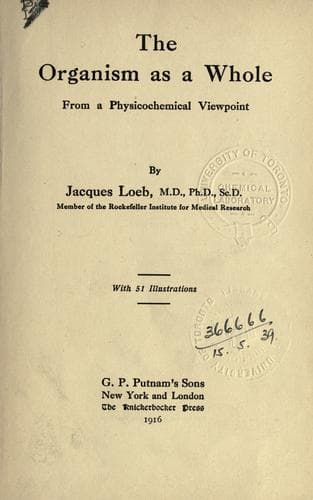
The Organism as a Whole, from a Physicochemical ViewpointLoeb, Jacques
Science
The Organism as a Whole, from a Physicochemical Viewpoint
Loeb, Jacques
Biology; Life (Biology); Mendel's law
Kastle and Loevenhart demonstrated the synthesis of a trace of
ethylbutyrate by lipase if the latter enzyme was added to the products
of the hydrolysis of ethylbutyrate, ethyl alcohol, and butyric acid
by the same enzyme.[19] Taylor[20] obtained the synthesis of a slight
amount of triolein
by the addition of the dried fat-free residue of the castor bean to
a mixture of oleinic acid and glycerine.... No synthesis occurred
with acetic, butyric, palmitic, and stearic acids with glycerine,
mannite, and dulcite, and the experiments with the last two
alcohols and oleinic acid likewise yielded no synthesis.
[19] Kastle, J. H., and Loevenhart, A. S., _Am. Chem. Jour._, 1900,
xxiv., 491.
[20] Taylor, A. E., _Univ. Cal. Pub._, 1904, _Pathology_, i., 33;
_Jour. Biol. Chem._, 1906, ii., 87.
This suggests possibly a specific action of the enzyme. If this slight
reversible action had any biological significance (which might be
possible, since in the organism secondary favourable conditions might
be at work which are lacking _in vitro_) there should be a parallelism
between masses of lipase in different kinds of tissues and fat
synthesis. Loevenhart indicated that this might be a fact, but a more
extensive investigation by H. C. Bradley has made this very dubious.[21]
[21] Bradley, H. C., _Jour. Biol. Chem._, 1913, xiii., 407.
Very little is known concerning the reversible action of the hydrolytic
protein enzymes. A. E. Taylor digested protamine sulphate with trypsin
and found that after adding trypsin to the products of digestion a
precipitate was formed after long standing; and we may also refer to
experiments of Robertson with pepsin on the products of caseinogen
to which we shall return in the next chapter. It therefore looks at
present as if van’t Hoff’s idea of reversible enzyme action might hold
in the modification offered by Armstrong. It remains doubtful, however,
whether this reversibility can explain all the synthetic processes in
the cell. No objection can be offered at present if any one makes the
assumption that each cell has specific synthetic enzymes or some other
synthetic mechanisms which are still unknown.
The mechanisms for the synthesis of proteins must have one other
peculiarity: they must be specific in their action. We shall see in the
next chapter that each species seems to possess one or more proteins
not found in any other but closely related species. Each organism
develops from a tiny microscopic germ and grows by synthetizing the
non-specific building stones (amino acids) into the specific proteins
of the species. This must be the work of the yet unknown synthetic
enzymes or mechanisms. The elucidation of their character would seem
one of the main problems of biology. Needless to say crystallography is
not confronted with problems of such a nature.
Public-domain text, read in full here on John Shaqi.
Reviews
Reviews
No reviews yet
Be the first to share your thoughts on this work.
Join the Discussion
Join the discussion
Sign in to leave a comment or review.
Sign InorCreate an account