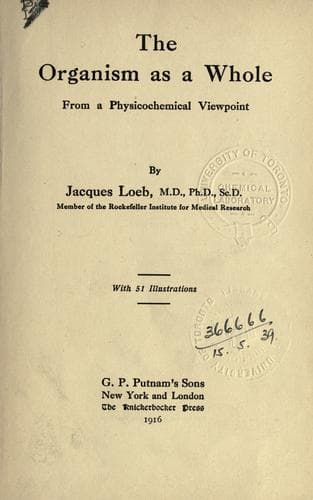
The Organism as a Whole, from a Physicochemical ViewpointLoeb, Jacques
Science
The Organism as a Whole, from a Physicochemical Viewpoint
Loeb, Jacques
Biology; Life (Biology); Mendel's law
It is generally admitted that the individual physiological processes,
such as digestion, metabolism, the production of heat or of
electricity, are of a purely physicochemical character; and it is also
conceded that the functions of individual organs, such as the eye
or the ear, are to be analysed from the viewpoint of the physicist.
When, however, the biologist is confronted with the fact that in the
organism the parts are so adapted to each other as to give rise to a
harmonious whole; and that the organisms are endowed with structures
and instincts calculated to prolong their life and perpetuate their
race, doubts as to the adequacy of a purely physicochemical viewpoint
in biology may arise. The difficulties besetting the biologist in this
problem have been rather increased than diminished by the discovery of
Mendelian heredity, according to which each character is transmitted
independently of any other character. Since the number of Mendelian
characters in each organism is large, the possibility must be faced
that the organism is merely a mosaic of independent hereditary
characters. If this be the case the question arises: What moulds these
independent characters into a harmonious whole?
The vitalist settles this question by assuming the existence of a
pre-established design for each organism and of a guiding “force”
or “principle” which directs the working out of this design. Such
assumptions remove the problem of accounting for the harmonious
character of the organism from the field of physics or chemistry. The
theory of natural selection invokes neither design nor purpose, but it
is incomplete since it disregards the physicochemical constitution of
living matter about which little was known until recently.
Public-domain text, read in full here on John Shaqi.
Reviews
Reviews
No reviews yet
Be the first to share your thoughts on this work.
Join the Discussion
Join the discussion
Sign in to leave a comment or review.
Sign InorCreate an account