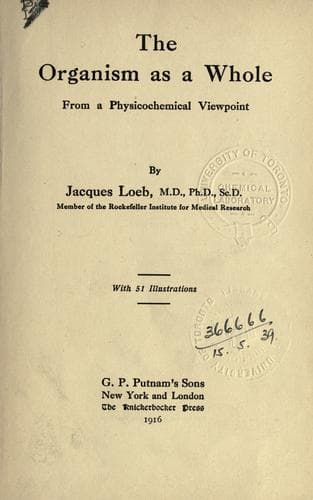
The Organism as a Whole, from a Physicochemical ViewpointLoeb, Jacques
Science
The Organism as a Whole, from a Physicochemical Viewpoint
Loeb, Jacques
Biology; Life (Biology); Mendel's law
In this book an attempt is made to show that the unity of the organism
is due to the fact that the egg (or rather its cytoplasm) is the future
embryo upon which the Mendelian factors in the chromosomes can impress
only individual characteristics, probably by giving rise to special
hormones and enzymes. We can cause an egg to develop into an organism
without a spermatozoön, but apparently we cannot make a spermatozoön
develop into an organism without the cytoplasm of an egg, although
sperm and egg nucleus transmit equally the Mendelian characters. The
conception that the cytoplasm of the egg is already the embryo in the
rough may be of importance also for the problem of evolution since
it suggests the possibility that the genus- and species-heredity are
determined by the cytoplasm of the egg, while the Mendelian hereditary
characters cannot contribute at all or only to a limited extent to
the formation of new species. Such an idea is supported by the work
on immunity, which shows that genus- and probably species-specificity
are due to specific proteins, while the Mendelian characters may be
determined by hormones which need neither be proteins nor specific or
by enzymes which also need not be specific for the species or genus.
Such a conception would remove the difficulties which the work on
Mendelian heredity has seemingly created not only for the problem of
evolution but also for the problem of the harmonious character of the
organism as a whole.
Since the book is intended as a companion volume to the writer’s former
treatise on _The Comparative Physiology of the Brain_ a discussion of
the functions of the central nervous system is omitted.
Completeness in regard to quotation of literature was out of the
question, but the writer notices with regret, that he has failed to
refer in the text to so important a contribution to the subject as
Sir E. A. Schäfer’s masterly presidential address on “Life” or the
addresses of Correns and Goldschmidt on the determination of sex.
Credit should also have been given to Professor Raymond Pearl for the
discrimination between species and individual inheritance.
The writer wishes to acknowledge his indebtedness to his friends
Professor E. G. Conklin of Princeton, Professor Richard Goldschmidt
of the Kaiser Wilhelm Institut of Berlin, Dr. P. A. Levene of the
Rockefeller Institute, Professor T. H. Morgan of Columbia University,
and Professor Hardolph Wasteneys of the University of California who
kindly read one or more chapters of the book and offered valuable
suggestions; and he wishes especially to thank his wife for suggesting
many corrections in the manuscript and the proof.
Public-domain text, read in full here on John Shaqi.
Reviews
Reviews
No reviews yet
Be the first to share your thoughts on this work.
Join the Discussion
Join the discussion
Sign in to leave a comment or review.
Sign InorCreate an account