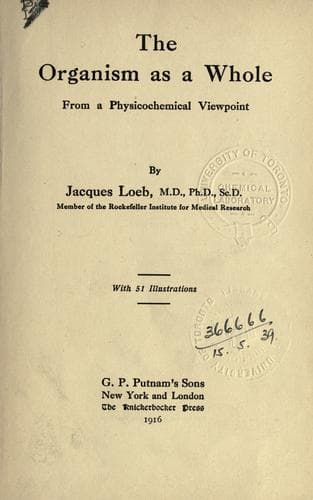
The Organism as a Whole, from a Physicochemical ViewpointLoeb, Jacques
Science
The Organism as a Whole, from a Physicochemical Viewpoint
Loeb, Jacques
Biology; Life (Biology); Mendel's law
[25] While this has been demonstrated thus far only for
connective-tissue cells it may be true also for other cells.
This effect of lack of oxygen explains also why the immortality of
the somatic cells is not obvious. Death in a human being consists in
the stopping of heart beat and respiration, which also terminates the
action of the brain or at least of consciousness. Immediately after the
cessation of heart beat and respiration the cells of muscle and of the
skin and probably many or most other organs are still alive and might
continue to live if transferred to another body with circulation and
respiration. As a consequence of the lack of oxygen supply in the dead
body they will, however, die comparatively rapidly. It may be stated
that hearts taken out of the body after a number of hours can still
beat again when put into the proper solutions and upon receiving an
adequate oxygen supply.
The idea that the body cells are naturally immortal and die only if
exposed to extreme injuries such as prolonged lack of oxygen or too
high a temperature helps to make one problem more intelligible. The
medical student, who for the first time realizes that life depends upon
that one organ, the heart, doing its duty incessantly for the seventy
years or so allotted to man, is amazed at the precariousness of our
existence. It seems indeed uncanny that so delicate a mechanism should
function so regularly for so many years. The mysticism connected with
this and other phenomena of adaptation would disappear if we could be
certain that all cells are really immortal and that the fact which
demands an explanation is not the continued activity but the cessation
of activity in death. Thus we see that the idea of the immortality of
the body cell if it can be generalized may be destined to become one
of the main supports for a complete physicochemical analysis of life
phenomena since it makes the durability of organisms intelligible.
5. This generalized idea of the immortality of some or possibly most
or all somatic cells has a bearing upon the problem of the origin of
life on our planet. The experiments of Spallanzani, Schwann, Schroeder,
Pasteur, Tyndall, and all those who have worked with pure cultures of
micro-organisms, have proved that no spontaneous generation of living
from non-living matter can be demonstrated; and the statements to the
contrary were due to experimental errors inasmuch as the new organisms
formed were the offspring of others which had entered into the culture
medium by mistake.
Public-domain text, read in full here on John Shaqi.
Reviews
Reviews
No reviews yet
Be the first to share your thoughts on this work.
Join the Discussion
Join the discussion
Sign in to leave a comment or review.
Sign InorCreate an account