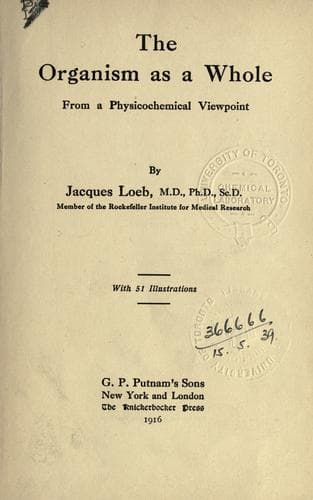
The Organism as a Whole, from a Physicochemical Viewpoint — John Shaqi
The Organism as a Whole, from a Physicochemical ViewpointLoeb, Jacques
Science
The Organism as a Whole, from a Physicochemical Viewpoint
Loeb, Jacques
Biology; Life (Biology); Mendel's law
In the last chapter of that most fascinating book _Worlds in the
Making_,[26] Arrhenius discusses the possibility of life being eternal
and of living germs of very small dimensions--_e. g._, the spores
of micro-organisms--being carried through space from one planet to
another or even from one solar system to another. If it be true that
there is no spontaneous generation; if it be true that all cells are
potentially immortal, we may indeed seriously raise the question: May
not life after all be eternal? Such ideas were advocated by Richter in
a rather phantastic way and more definitely by Helmholtz as well as
Kelvin. The latter authors assumed that in the collision of planets or
worlds on which there is life, fragments containing living organisms
will be torn off and these fragments will move as seed-bearing stones
through space. “If at the present instant no life existed upon this
earth, one such stone falling upon it might ... lead to its becoming
covered with vegetation.” Arrhenius points out the difficulties which
oppose such a view, as, _e. g._, the fact “that the meteorite in its
fall towards the earth becomes incandescent all over its surface and
any seeds on it would therefore be deprived of their germinating power.”
[26] Arrhenius, S., _Worlds in the Making_, London and New York, 1908,
p. 212.
Arrhenius suggests another and much more ingenious idea based on the
fact that for particles below a certain size the mechanical pressure
produced by light waves--the radiation pressure--can overcome the
attractive force of gravitation.
Bodies which according to Schwarzschild would undergo the strongest
influence of solar radiation must have a diameter of 0.00016 mm.
supposing them to be spherical. The first question is therefore:
Are there any living seeds of such extraordinary minuteness? The
reply of the botanist is that spores of many bacteria have a size
of 0.0003 or 0.0002 mm., and there are no doubt much smaller germs
which our microscopes fail to disclose.
This assumption is undoubtedly correct.
We will, in the first instance, make a rough calculation of what
would happen if such an organism were detached from the earth
and pushed out into space by the radiation pressure of our sun.
The organism would first of all have to cross the orbit of Mars;
then the orbits of the smaller and of the outer planets.... The
organisms would cross the orbit of Mars after twenty days, the
Jupiter orbit after eighty days, and the orbit of Neptune after
fourteen months. Our nearest solar system would be reached in nine
thousand years.
Public-domain text, read in full here on John Shaqi.
Reviews
Reviews
No reviews yet
Be the first to share your thoughts on this work.
Join the Discussion
Join the discussion
Sign in to leave a comment or review.
Sign InorCreate an account