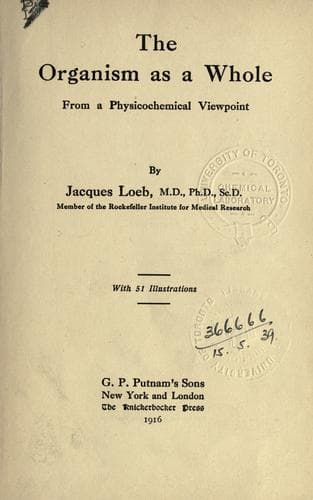
The Organism as a Whole, from a Physicochemical ViewpointLoeb, Jacques
Science
The Organism as a Whole, from a Physicochemical Viewpoint
Loeb, Jacques
Biology; Life (Biology); Mendel's law
In the cosmic space there is no water vapour, no atmosphere, and a
low temperature, and there is hence no reason why spores should lose
appreciably more of their germinating power in ten thousand years than
in six months. We must therefore admit the possibility that spores may
move for an almost infinite length of time through cosmic space and
yet be ready for germination when they fall upon a planet in which all
the conditions for germination and development exist, _e. g._, water,
proper temperature, and the right nutritive substances dissolved in the
water (inclusive of free oxygen).
While thus everything is favourable to Arrhenius’s hypothesis,
Becquerel raises the objection that the spores going through space
would yet be destroyed by ultraviolet light. This danger would
probably exist only as long as the germ is not too far from a sun. The
difficulty is a real one since the ultraviolet rays have a destructive
effect even in the absence of oxygen. It is possible, however, that
there are spores which can resist this effect of ultraviolet light.
Arrhenius’s theory can not of course be disproved and we must agree
with him that it is consistent not only with the theories of cosmogony
but also with the seeming potential immortality of certain or of all
cells.
The alternative to Arrhenius’s theory is that living matter did
originate and still originates from non-living matter. If this idea is
correct it should one day be possible to discover synthetic enzymes
which are capable of forming molecules of their own kind from a simple
nutritive solution. With such synthetic enzymes as a starting point
the task might be undertaken of creating cells capable of growth and
cell division, at least in the apparently simple form in which these
phenomena occur in bacteria; viz., that after the mass has reached a
certain (still microscopic) size it divides into two cells and so on.
If Arrhenius is right that living matter has had no more beginning
than matter in general, this hope of making living matter artificially
appears at present as futile as the hope of making molecules out of
electrons.
The problem of making living matter artificially has been compared to
that of constructing a _perpetuum mobile_; this comparison is, however,
not correct. The idea of a _perpetuum mobile_ contradicts the first law
of thermodynamics, while the making of living matter may be impossible
though contradicting no natural law.
Public-domain text, read in full here on John Shaqi.
Reviews
Reviews
No reviews yet
Be the first to share your thoughts on this work.
Join the Discussion
Join the discussion
Sign in to leave a comment or review.
Sign InorCreate an account