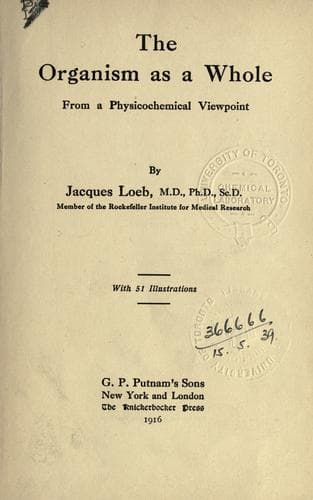
The Organism as a Whole, from a Physicochemical Viewpoint — John Shaqi
The Organism as a Whole, from a Physicochemical ViewpointLoeb, Jacques
Science
The Organism as a Whole, from a Physicochemical Viewpoint
Loeb, Jacques
Biology; Life (Biology); Mendel's law
Pasteur’s proof that spontaneous generation does not occur in the
solutions used by him does not prove that a synthesis of living
from dead matter is impossible under any conditions. It is at least
not inconceivable that in an earlier period of the earth’s history
radio-activity, electrical discharges, and possibly also the action of
volcanoes might have furnished the combination of circumstances under
which living matter might have been formed. The staggering difficulties
in imagining such a possibility are not merely on the chemical
side--_e. g._, the production of proteins from CO₂, and N--but also
on the physical side if the necessity of a definite cell structure is
considered. We shall see in the sixth chapter that without a structure
in the egg to begin with, no formation of a complicated organism is
imaginable; and while a bacterium may have a simple structure, such a
structure as it possesses is as necessary for its existence as are its
enzymes.
Attempts have repeatedly been made to imitate the structures in the
cell and of living organisms by colloidal precipitates. It is needless
to point out that such precipitates are of importance only for the
study of the origin of structures in the living, but that they are
not otherwise an imitation of the living since they are lacking the
characteristic synthetic chemical processes.
CHAPTER III
THE CHEMICAL BASIS OF GENUS AND SPECIES
1. It is a truism that from an egg of a species an organism of this
species only and of no other will arise. It is also a truism that
the so-called protoplasm of an egg does not differ much from that
of eggs of other species when looked at through a microscope. The
question arises: What determines the species of the future organism?
Is it a structure or a specific chemical or groups of chemicals? In a
later chapter we shall show that the egg has a simple though definite
structure, but in this chapter we shall see that the egg must contain
specific substances and that these substances which determine the
“species” and specificity in general are in all probability proteins.
Since solutions of different proteins look alike under a microscope we
need not wonder that it is impossible to discriminate microscopically
between the protoplasm of different eggs.
Public-domain text, read in full here on John Shaqi.
Reviews
Reviews
No reviews yet
Be the first to share your thoughts on this work.
Join the Discussion
Join the discussion
Sign in to leave a comment or review.
Sign InorCreate an account