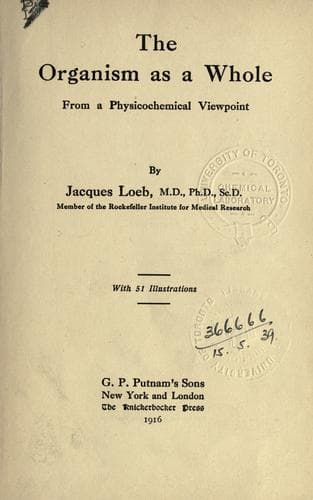
The Organism as a Whole, from a Physicochemical ViewpointLoeb, Jacques
Science
The Organism as a Whole, from a Physicochemical Viewpoint
Loeb, Jacques
Biology; Life (Biology); Mendel's law
1. The physical researches of the last ten years have put the atomistic
theory of matter and electricity on a definite and in all probability
permanent basis. We know the exact number of molecules in a given
mass of any substance whose molecular weight is known to us, and we
know the exact charge of a single electron. This permits us to state
as the ultimate aim of the physical sciences the visualization of
all phenomena in terms of groupings and displacements of ultimate
particles, and since there is no discontinuity between the matter
constituting the living and non-living world the goal of biology can be
expressed in the same way.
This idea has more or less consciously prevailed for some time in the
explanation of the single processes occurring in the animal body or
in the explanation of the functions of the individual organs. Nobody,
not even a scientific vitalist, would think of treating the process
of digestion, metabolism, production of heat, and electricity or even
secretion or muscular contraction in any other than a purely chemical
or physicochemical way; nor would anybody think of explaining the
functions of the eye or the ear from any other standpoint than that of
physics.
When the actions of the organism as a whole are concerned, we find
a totally different situation. The same physiologists who in the
explanation of the individual processes would follow the strictly
physicochemical viewpoint and method would consider the reactions of
the organism as a whole as the expression of non-physical agencies.
Thus Claude Bernard,[1] who in the investigation of the individual
life processes was a strict mechanist, declares that the making of a
harmonious organism from the egg cannot be explained on a mechanistic
basis but only on the assumption of a “directive force.” Bernard
assumes, as Bichat and others had done before him, that there are two
opposite processes going on in the living organism: (1) the phenomena
of vital creation or organizing synthesis; (2) the phenomena of death
or organic destruction. It is only the destructive processes which give
rise to the physical manifestations by which we judge life, such as
respiration and circulation or the activity of glands, and so on. The
work of creation takes place unseen by us in the egg when the embryo
or organism is formed. This vital creation occurs always according to
a definite plan, and in the opinion of Bernard it is impossible to
account for this plan on a purely physicochemical basis.
[1] Bernard C., _Leçons sur les Phénomènes de la Vie_. Paris, 1885, i.,
22-64.
There is so to speak a pre-established design of each being and of
each organ of such a kind that each phenomenon by itself depends
upon the general forces of nature, but when taken in connection
with the others it seems directed by some invisible guide on the
road it follows and led to the place it occupies....
Public-domain text, read in full here on John Shaqi.
Reviews
Reviews
No reviews yet
Be the first to share your thoughts on this work.
Join the Discussion
Join the discussion
Sign in to leave a comment or review.
Sign InorCreate an account