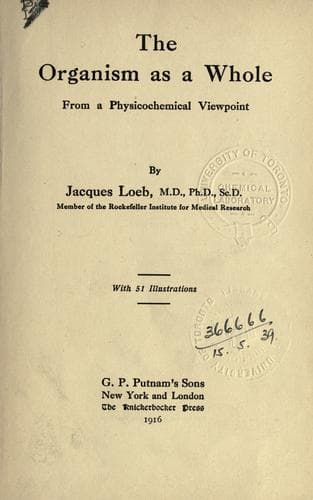
The Organism as a Whole, from a Physicochemical ViewpointLoeb, Jacques
Science
The Organism as a Whole, from a Physicochemical Viewpoint
Loeb, Jacques
Biology; Life (Biology); Mendel's law
We admit that the life phenomena are attached to physicochemical
manifestations, but it is true that the essential is not explained
thereby; for no fortuitous coming together of physicochemical
phenomena constructs each organism after a plan and a fixed
design (which are foreseen in advance) and arouses the admirable
subordination and harmonious agreement of the acts of life....
We can only know the material conditions and not the intimate
nature of life phenomena. We have therefore only to deal with
matter and not with the first causes or the vital force derived
therefrom. These causes are inaccessible to us, and if we believe
anything else we commit an error and become the dupes of metaphors
and take figurative language as real.... Determinism can never be
but physicochemical determinism. The vital force and life belong to
the metaphysical world.
In other words, Bernard thinks it his task to account for individual
life phenomena on a purely physicochemical basis--but the harmonious
character of the organism as a whole is in his opinion not produced
by the same forces and he considers it impossible and hopeless
to investigate the “design.” This attitude of Bernard would be
incomprehensible were it not for the fact that, when he made these
statements, the phenomena of specificity, the physiology of development
and regeneration, the Mendelian laws of heredity, the animal tropisms
and their bearing on the theory of adaptation were unknown.
This explanation of Bernard’s attitude is apparently contradicted by
the fact that Driesch[2] and v. Uexküll,[3] both brilliant biologists,
occupy today a standpoint not very different from that of Claude
Bernard. Driesch assumes that there is an Aristotelian “entelechy”
acting as directing guide in each organism; and v. Uexküll suggests
a kind of Platonic “idea” as a peculiar characteristic of life which
accounts for the purposeful character of the organism.
Public-domain text, read in full here on John Shaqi.
Reviews
Reviews
No reviews yet
Be the first to share your thoughts on this work.
Join the Discussion
Join the discussion
Sign in to leave a comment or review.
Sign InorCreate an account