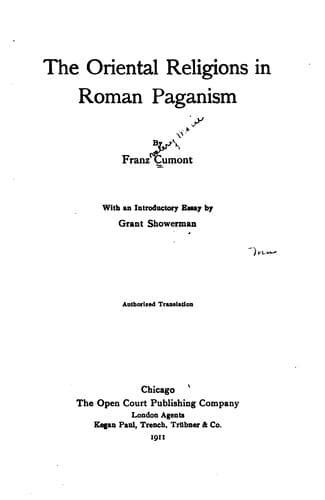
The Oriental Religions in Roman PaganismCumont, Franz
Religion
The Oriental Religions in Roman Paganism
Cumont, Franz
Paganism -- Rome; Religions; Rome -- Religion
An illustration will make my thought clearer. The votaries of Mithra
likened the practice of their religion to military service. When the
neophyte joined he was compelled to take an oath (_sacramentum_) similar to
the one required of recruits in the army, and there is no doubt that an
indelible mark was likewise branded on his body with a hot iron. The third
degree of the mystical hierarchy was that of "soldier" (_miles_).
Thenceforward the initiate belonged to the sacred militia of the invincible
god and fought the powers of evil under his orders. All these ideas and
institutions are so much in accord with what we know of Mazdean dualism, in
which the entire life was conceived as a struggle against the malevolent
spirits; they are so inseparable from the history even of Mithraism, which
always was a soldiers' religion, that we cannot doubt they belonged to it
before its appearance in the Occident.
On the other hand, we find similar conceptions in Christianity. The society
of the faithful--the term is still in use--is the "Church Militant." During
the first centuries the comparison of the church with an army was carried
out even in details;[5] the baptism of the neophyte was the oath of
fidelity to the flag taken by the recruits. Christ was the "emperor," the
commander-in-chief, of his disciples, who formed cohorts triumphing under
his command over the demons; the apostates were deserters; the sanctuaries,
camps; the pious practices, drills and sentry-duty, and so on.
If we consider that the gospel preached peace, that for a long time the
Christians felt a repugnance to military service, where their faith was
threatened, we are tempted to admit _a priori_ an influence of the
belligerent cult of Mithra upon Christian thought. {xx}
But this is not the case. The theme of the _militia Christi_ appears in the
oldest ecclesiastical authors, in the epistles of St. Clement and even in
those of St. Paul. It is impossible to admit an imitation of the Mithraic
mysteries then, because at that period they had no importance whatever.
But if we extend our researches to the history of that notion, we shall
find that, at least under the empire, the mystics of Isis were also
regarded as forming sacred cohorts enlisted in the service of the goddess,
that previously in the Stoic philosophy human existence was frequently
likened to a campaign, and that even the astrologers called the man who
submitted to destiny and renounced all revolt a "soldier of fate."[6]
Public-domain text, read in full here on John Shaqi.
Reviews
Reviews
No reviews yet
Be the first to share your thoughts on this work.
Join the Discussion
Join the discussion
Sign in to leave a comment or review.
Sign InorCreate an account