The Oriental Religions in Roman Paganism — John Shaqi
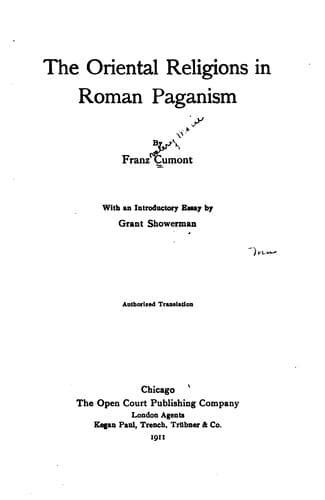
The Oriental Religions in Roman PaganismCumont, Franz
Religion
The Oriental Religions in Roman Paganism
Cumont, Franz
Paganism -- Rome; Religions; Rome -- Religion
This conception of life, especially of religious life, was therefore very
popular from the beginning of our era. It was manifestly prior both to
Christianity and to Mithraism. It developed in the military monarchies of
the Asiatic Diadochi. Here the soldier was no longer a citizen defending
his country, but in most instances a volunteer bound by a sacred vow to the
person of his king. In the martial states that fought for the heritage of
the Achemenides this personal devotion dominated or displaced all national
feeling. We know the oaths taken by those subjects to their deified
kings.[7] They agreed to defend and uphold them even at the cost of their
own lives, and always to have the same friends and the same enemies as
they; they dedicated to them not only their actions and words, but their
very thoughts. Their duty was a complete abandonment of their personality
in favor of those monarchs who were held the equals of the gods. The sacred
_militia_ of the mysteries was nothing but this civic {xxi} morality viewed
from the religious standpoint. It confounded loyalty with piety.
As we see, the researches into the doctrines or practices common to
Christianity and the Oriental mysteries lead almost always beyond the
limits of the Roman empire into the Hellenistic Orient. The religious
conceptions which imposed themselves on Latin Europe under the Caesars[8]
were developed there, and it is there we must look for the key to enigmas
still unsolved. It is true that at present nothing is more obscure than the
history of the religions that arose in Asia when Greek culture came in
contact with barbarian theology. It is rarely possible to formulate
satisfactory conclusions with any degree of certainty, and before further
discoveries are made we shall frequently be compelled to weigh contrasting
probabilities. We must frequently throw out the sounding line into the
shifting sea of possibility in order to find secure anchorage. But at any
rate we perceive with sufficient distinctness the direction in which the
investigations must be pursued.
It is our belief that the main point to be cleared up is the composite
religion of those Jewish or Jewish-pagan communities, the worshipers of
Hypsistos, the Sabbatists, the Sabaziasts and others in which the new creed
took root during the apostolic age. In those communities the Mosaic law had
become adapted to the sacred usages of the Gentiles even before the
beginning of our era, and monotheism had made concessions to idolatry. Many
beliefs of the ancient Orient, as for instance the ideas of Persian dualism
regarding the infernal world, arrived in Europe by two roads, the more or
less orthodox Judaism of the communities of {xxii} the dispersion in which
the gospel was accepted immediately, and the pagan mysteries imported from
Syria or Asia Minor. Certain similarities that surprised and shocked the
apologists will cease to look strange as soon as we reach the distant
sources of the channels that reunited at Rome.
Public-domain text, read in full here on John Shaqi.
Reviews
Reviews
No reviews yet
Be the first to share your thoughts on this work.
Join the Discussion
Join the discussion
Sign in to leave a comment or review.
Sign InorCreate an account