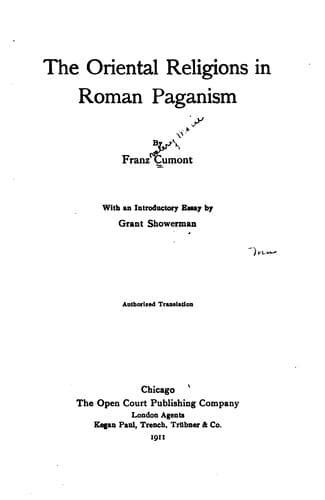
The Oriental Religions in Roman PaganismCumont, Franz
Religion
The Oriental Religions in Roman Paganism
Cumont, Franz
Paganism -- Rome; Religions; Rome -- Religion
61. The infiltration of magic into the liturgy under the Roman empire is
shown especially in connection with the ritual of consecration of the
idols, by Hock, _Griechische Weihegebraeuche_, Wuerzburg, 1905, p. 66.--Cf.
also Kroll, _Archiv fuer Religionsw._, VIII, 1905, Beiheft, pp. 27 ff.
62. Friedlaender, _Sittengeschichte_, I, pp. 509 f.
63. Arnobius, II, 62, cf. II, 13; Ps.-Iamblichus, _De Myst._, VIII, 4.
64. Magic in Egypt: Budge, _Egyptian Magic_, London, 1901; Wiedemann,
_Magie und Zauberei im alten Aegypten_, Leipsic, 1905 [cf. Maspero, _Rev.
critique_, 1905, II, p. 166]; Otto, _Priester und Tempel_, II, p. 224;
Griffith, _The Demotic Magical Papyrus of London and Leiden_, 1904 (a
remarkable collection dating back to the third century of our era), and the
writings analyzed by Capart, _Rev. hist. des relig._, 1905 (Bulletin of
1904, p. 17), 1906 (Bull. of 1905, p. 92).
65. Fossey, _La magie assyrienne_, Paris, 1902. The earlier bibliography
will be found p. 7. See also Hubert in Daremberg, Saglio, Pottier, _Dict.
des antiq._, s. v. "Magia," p. 1505, n. 5. Campbell Thomson, _Semitic
Magic, Its Origin and Development_, London, 1908.
Traces of magical conceptions have survived even in the prayers of the
orthodox Mohammedans; see the curious {279} observations of Goldziher,
_Studien, Theodor Noeldeke gewidmet_, 1906, I, pp. 302 ff. The
Assyrio-Chaldean magic may be compared profitably with Hindu magic (Victor
Henry, _La Magie dans l'Inde antique_, Paris, 1904).
66. There are many indications that the Chaldean magic spread over the
Roman empire, probably as a consequence of the conquests of Trajan and
Verus (Apul., _De Magia_, c. 38; Lucian, _Philopseudes_, c. 11; _Necyom._,
c. 6, etc. Cf. Hubert, loc. cit.) Those most influential in reviving these
studies seem to have been two rather enigmatical personages, Julian the
Chaldean, and his son Julian the Theurge, who lived under Marcus Aurelius.
The latter was Considered the author of the [Greek: Logia Chaldaika], which
in a measure became the Bible of the last neo-Platonists.
67. Apul., _De Magia_, c. 27. The name [Greek: philosophos], _philosophus_,
was finally applied to all adepts in the occult sciences.
68. The term seems to have been first used by Julian, called the Theurge,
and thence to have passed to Porphyry (_Epist. Aneb._, c. 46; Augustine,
_Civ. Dei_, X, 9-10) and to the neo-Platonists.
Public-domain text, read in full here on John Shaqi.
Reviews
Reviews
No reviews yet
Be the first to share your thoughts on this work.
Elsewhere in the archive
Join the Discussion
Join the discussion
Sign in to leave a comment or review.
Sign InorCreate an account