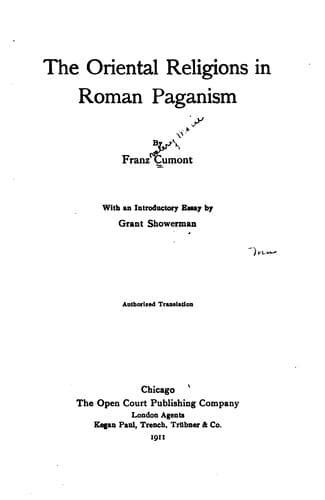
The Oriental Religions in Roman PaganismCumont, Franz
Religion
The Oriental Religions in Roman Paganism
Cumont, Franz
Paganism -- Rome; Religions; Rome -- Religion
69. Hubert, article cited, pp. 1494, n. 1; 1499 f.; 1504. Ever since
magical papyri were discovered in Egypt, there has been a tendency to
exaggerate the influence exercised by that country on the development of
magic. It made magic prominent as we have said, but a study of these same
papyri proves that elements of very different origin had combined with the
native sorcery, which seems to have laid special stress upon the importance
of the "barbarian names," because to the Egyptians the name had a reality
quite independent of the object denoted by it, and possessed an effective
force of its own (_supra_, pp. 93, 95). But that is, after all, only an
incidental theory, and it is significant that in speaking of the origin of
magic, Pliny (XXX, 7) names the Persians in the first place, and does not
even mention the Egyptians.
70. _Mon. myst. Mithra_, I, pp. 230 ff.--Consequently Zoroaster, the
undisputed master of the magi, is frequently considered a disciple of the
Chaldeans or as himself coming from Babylon. The blending of Persian and
Chaldean beliefs appears clearly in Lucian, _Necyom._, 6 ff. {280}
71. The majority of the magical formulas attributed to Democritus are the
work of forgers like Bolos of Mendes (cf. Diels, _Fragmente der
Vorsokratiker_, I^2, pp. 440 f.), but the authorship of this literature
could not have been attributed to him, had not these tendencies been so
favorable.
72. On Jewish magic see: Blau, _Das altjuedische Zauberwesen_, 1898; cf.
Hubert, _loc. cit._, p. 1505.
73. Pliny, _H. N._, XXX, 1, Sec. 6; Juvenal, VI, 548 ff. In Pliny's opinion
these magicians were especially acquainted with _veneficas artes_. The
toxicology of Mithridates goes back to that source (Pliny, XXV, 2, 7). Cf.
Horace, _Epod._, V, 21; Virgil, _Buc._ VIII, 95, etc.
74. Cf. _supra_, pp. 151 ff.
75. Minucius Felix, _Octavius_, 26; cf. _supra_, ch. VI, p. 152.
76. In a passage outlining the Persian demonology (see _supra_, n. 39),
Porphyry tells us (_De Abst._, II, 41):
[Greek: Toutous] (sc. [Greek: tous daimonas]) [Greek: malista kai ton
proestota auton] (c. 42, [Greek: he proestosa auton dunamis] = Ahriman)
[Greek: ektimosin hoi ta kaka dia ton goeteion prattomenoi k. t. l.] Cf.
Lactantius, _Divin. Inst._, II, 14 (I, p. 164, 10, Brandt ed.); Clem. of
Alexandria, _Stromat._, III, p. 46 C, and _supra_, n. 37. The idea that the
demons subsisted on the offerings and particularly on the smoke of the
sacrifices agrees entirely with the old Persian and Babylonian ideas. See
Yasht V, XXI, 94: What "becomes of the libations which the wicked bring to
you after sunset?" "The devas receive them," etc.--In the cuneiform tablet
of the deluge (see 160 ff.), the gods "smell the good odor and gather above
the officiating priest like flies." (Dhorme, _Textes religieux
assyro-babyloniens_, 1907, p. 115; cf. Maspero, _Hist. anc. des peuples de
l'Orient_, I, p. 681.).
77. Plut., _De Iside_, c. 46.
Public-domain text, read in full here on John Shaqi.
Reviews
Reviews
No reviews yet
Be the first to share your thoughts on this work.
Elsewhere in the archive
Join the Discussion
Join the discussion
Sign in to leave a comment or review.
Sign InorCreate an account