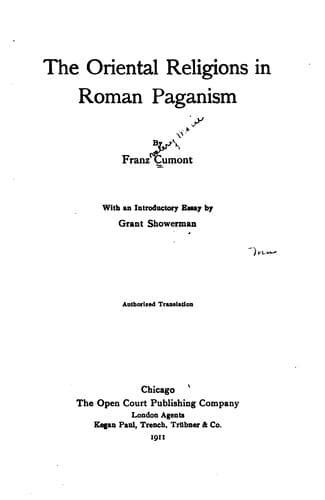
The Oriental Religions in Roman PaganismCumont, Franz
Religion
The Oriental Religions in Roman Paganism
Cumont, Franz
Paganism -- Rome; Religions; Rome -- Religion
78. The _druj Nasu_ of the Mazdeans; cf. Darmesteter, _Zend-Avesta_, II, p.
xi and 146 ff.
79. Cf. Lucan, _Phars._, VI, 520 ff.
80. Mommsen, _Strafrecht_, pp. 639 ff. There is no doubt that the
legislation of Augustus was directed against magic, cf. Dion, LII, 34,
3.--Manilius (II, 108) opposes to astrology the {281} _artes quorum haud
permissa facultas_. Cf. also Suet., _Aug._, 31.
81. Zachariah the Scholastic, _Vie de Severe d'Antioche_, Kugener ed.
(_Patrol. orientalis_, II), 1903, pp. 57 ff.
82. Magic at Rome in the fifth century: Wuensch, _Sethianische
Verfluchungstafeln aus Rom_, Leipsic, 1898 (magical leads dated from 390 to
420); _Revue hist. litt. relig._, VIII, 1903, p. 435, and Burchardt, _Die
Zeit Constantin's_, 2d ed., 1880, pp. 236 ff.
VIII. THE TRANSFORMATION OF PAGANISM.
BIBLIOGRAPHY: The history of the destruction of paganism is a subject that
has tempted many historians. Beugnot (1835), Lasaulx (1854), Schulze (Jena,
1887-1892) have tried it with varying success (see Wissowa, _Religion der
Roemer_, pp. 84 ff.). But hardly any one has been interested in the
reconstruction of the theology of the last pagans, although material is not
lacking. The meritorious studies of Gaston Boissier (_La fin du Paganisme_,
Paris, 1891) treat especially the literary and moral aspects of that great
transformation. Allard (_Julien l'Apostat_, I, 1900, p. 39 ff.) has
furnished a summary of the religious evolution during the fourth century.
1. Socrates, _Hist. Eccl._, IV, 32.
2. It is a notable fact that astrology scarcely penetrated at all into the
rural districts (_supra_, ch. VII, n. 9), where the ancient devotions
maintained themselves; see the _Vita S. Eligii_, Migne, _P. L._, XL, col.
1172 f.--In the same way the cult of the menhirs in Gaul persisted in the
Middle Ages; see d'Arbois de Jubainville, _Comptes Rendus Acad. Inscr._,
1906, pp. 146 ff.; S. Reinach, _Mythes, cultes_, III, 1908, pp. 365 ff.
3. Aug., _Civ. Dei_, IV, 21 _et passim_. Arnobius and Lactantius had
previously developed this theme.
4. On the use made of mythology during the fourth century, cf. Burckhardt,
_Zeit Contantins_, 2d ed., 1880, pp. 145-147; Boissier, _La fin du
paganisme_, II, pp. 276 ff. and _passim_. {282}
5. It is well known that the poems of Prudentius (348-410), especially the
Peristephanon, contain numerous attacks on paganism and the pagans.
6. Cf. _La polemique de l'Ambrosiaster contre les paiens_ (_Rev. hist. et
litt. relig._, VIII, 1903, pp. 418 ff.). On the personality of the author
(probably the converted Jew Isaac), cf. Souter, _A Study of Ambrosiaster_,
Cambridge, 1905 (_Texts and Studies_, VII) and his edition of the
_Quaestiones_, (Vienna, 1908), intr. p. xxiv.
7. The identity of Firmicus Maternus, the author of _De errore profanarum
religionum_, and that of the writer of the eight books _Matheseos_ appears
to have been definitely established.
Public-domain text, read in full here on John Shaqi.
Reviews
Reviews
No reviews yet
Be the first to share your thoughts on this work.
Elsewhere in the archive
Join the Discussion
Join the discussion
Sign in to leave a comment or review.
Sign InorCreate an account