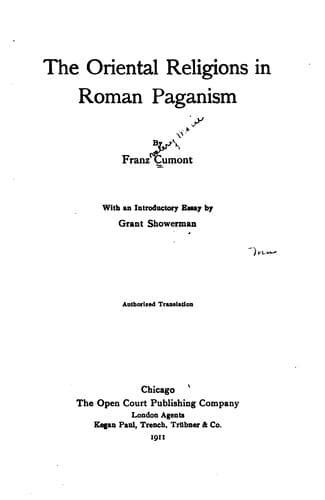
The Oriental Religions in Roman PaganismCumont, Franz
Religion
The Oriental Religions in Roman Paganism
Cumont, Franz
Paganism -- Rome; Religions; Rome -- Religion
8. Maximus was Bishop of Turin about 458-465 A. D. We possess as yet only a
very defective edition of the treatises _Contra Paganos_ and _Contra
Judaeos_ (Migne, _Patr. lat._, LVII, col. 781 ff.).
9. Particularly the _Carmen adversus paganos_ written after Eugene's
attempt at restoration in 394 A. D. (Riese, _Anthol. lat._, I, 20) and the
_Carmen ad senatorem ad idolorum servitutem conversum_, attributed to St.
Cyprian (Hartel. ed., III, p. 302), which is probably contemporaneous with
the former.
10. On this point see the judicious reflections of Paul Allard, _Julien
l'Apostat_, I, 1900, p. 35.
11. Hera was the goddess of the air after the time of the Stoics ([Greek:
Hera] = [Greek: aer]).
12. Cf. _supra_, pp. 51, 75, 99, 120, 148. Besides the Oriental gods the
only ones to retain their authority were those of the Grecian mysteries,
Bacchus and Hecate, and even these were transformed by their neighbors.
13. The wife of Praetextatus, after praising his career and talents in his
epitaph, adds: "Sed ista parva: tu pius mystes sacris | teletis reperta
mentis arcano premis, | divumque numen multiplex doctus colis" (_CIL_, 1779
= Dessau, _Inscr. sel._, 1259).
14. Pseudo-August. [Ambrosiaster], _Quaest. Vet. et Nov. Test._, (p. 139,
9-11, Souter ed.): "Paganos elementis esse {283} subiectos nulli dubium
est.... Paganos elementa colere omnibus cognitum est"; cf. 103 (p. 304, 4
Souter ed.): "Solent (pagani) ad elementa confugere dicentes haec se colere
quibus gubernaculis regitur vita humana" (cf. _Rev. hist. lit. rel._, VIII,
1903, p. 426, n. 3).--Maximus of Turin (Migne, _P. L._, LVII, 783): "Dicunt
pagani: nos solem, lunam et stellas et universa elementa colimus et
veneramur." Cf. _Mon myst. Mithra_, I, p. 103, n. 4, p. 108.
15. Firmicus Maternus, _Mathes._, VII prooem: "(Deus) qui ad fabricationem
omnium elementorum diversitate composita ex contrariis et repugnantibus
cuncta perfecit."
16. _Elementum_ is the translation of [Greek: stoicheion], which has had
the same meaning in Greek at least ever since the first century (see Diels,
_Elementum_, 1899, pp. 44 ff., and the Septuagint, Sap. Sal., 7, 18; 19,
17.) Pfister, "_Die [Greek: stoicheia tou kosmou] in den Briefen des
Paulus_," _Philologus_, LXIX, 1910, p. 410.--In the fourth century this
meaning was generally accepted: Macrobius, _Somn. Scipionis_, I, 12, Sec. 16:
"Caeli dico et siderum, aliorumque elementorum"; cf. I, 11, Sec. 7 ff.
Martianus Capella, II, 209; Ambrosiaster, _loc. cit._; Maximus of Turin,
_loc. cit._; Lactantius, II, 13, 2: "Elementa mundi, caelum, solem, terram,
mare."--Cf. Diels, _op. cit._, pp. 78 ff.
Public-domain text, read in full here on John Shaqi.
Reviews
Reviews
No reviews yet
Be the first to share your thoughts on this work.
Elsewhere in the archive
Join the Discussion
Join the discussion
Sign in to leave a comment or review.
Sign InorCreate an account