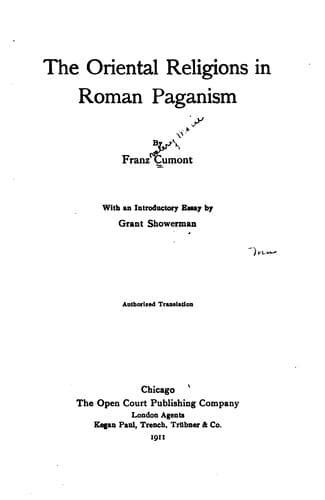
The Oriental Religions in Roman PaganismCumont, Franz
Religion
The Oriental Religions in Roman Paganism
Cumont, Franz
Paganism -- Rome; Religions; Rome -- Religion
17. Cf. _Rev. hist. litt. rel._, VIII, 1903, pp. 429 ff.--Until the end of
the fifth century higher education in the Orient remained in the hands of
the pagans. The life of Severus of Antioch, by Zachariah the Scholastic,
preserved in a Syrian translation [_supra_, ch. VII, n. 81], is
particularly instructive in this regard. The Christians, who were opposed
to paganism and astrology, consequently manifested an aversion to the
profane sciences in general, and in that way they became responsible to a
serious extent for the gradual extinction of the knowledge of the past (cf.
_Rev. hist. litt. rel._, _ibid._, p. 431; Royer, _L'enseignement d'Ausone a
Alcuin_, 1906, p. 130 ff.). But it must be said in their behalf that before
them Greek philosophy had taught the vanity of every science that did not
have the moral culture of the ego for its purpose, see Geffcken, _Aus der
Werdezeit des Christentums_, p. 7, p. 111.
18. _Mon. myst. Mithra_, I, p. 294. Cf. _supra_, pp. 175 f. {284}
19. Ambrosiaster, _Comm. in Epist. Pauli_, p. 58 B: "Dicentes per istos
posse ire ad Deum sicut per comites pervenire ad regem" (cf. _Rev. his.
lit. rel._, VIII, 1903, p. 427).--The same idea was set forth by Maximus of
Turin (_Adv. pag._, col. 791) and by Lactantius (_Inst. div._, II, 16, Sec. 5
ff., p. 168 Brandt); on the celestial court, see also Arnobius, II, 36;
Tertullian, _Apol._, 24.--Zeus bore the name of king, but the Hellenic
Olympus was in reality a turbulent republic. The conception of a supreme
god, the sovereign of a hierarchical court, seems to have been of Persian
origin, and to have been propagated by the magi and the mysteries of
Mithra. The inscription of the Nemroud Dagh speaks of [Greek: Dios
Oromasdou thronous] (_supra_, ch. VI, n. 26), and, in fact, a bas-relief
shows Zeus-Oramasdes sitting on a throne, scepter in hand. The Mithra
bas-reliefs likewise represent Jupiter Ormuzd on a throne, with the other
gods standing around him (_Mon. myst. Mithra_, I, p. 129; II, p. 188, fig.
11); and Hostanes pictured the angels sitting around the throne of God
(_supra_, ch. VI, n. 38; see Rev. iv). Moreover, the celestial god was
frequently compared, not to a king in general, but to the Great King, and
people spoke of his satraps; cf. Pseudo-Arist., [Greek: Peri kosmou], c. 6,
p. 398 _a_, 10 ff. = Apul., _De mundo_, c. 26; Philo, _De opif. mundi_, c.
23, 27 (p. 24, 17; 32, 24, Cohn); Maximus of Turin, X, 9; and Capelle, _Die
Schrift von der Welt_ (_Neue Jahrb. fuer das klass. Altert._, VIII), 1905,
p. 556, n. 6. Particularly important is a passage of Celsus (Origen,
_Contra Cels._, VIII, 35) where the relation of this doctrine to the
Persian demonology is shown. But the Mazdean conception must have combined,
at an early date, with the old Semitic idea that Baal was the lord and
master of his votaries (_supra_, p. 94 ff.). In his _Neutestamentliche
Zeitgeschichte_, (2d. ed., 1906, p. 364 ff.), Holtzmann insists on the fact
Public-domain text, read in full here on John Shaqi.
Reviews
Reviews
No reviews yet
Be the first to share your thoughts on this work.
Elsewhere in the archive
Join the Discussion
Join the discussion
Sign in to leave a comment or review.
Sign InorCreate an account