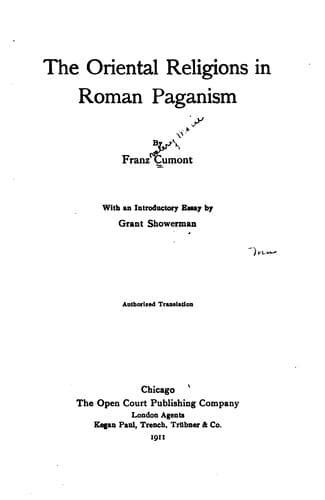
The Oriental Religions in Roman PaganismCumont, Franz
Religion
The Oriental Religions in Roman Paganism
Cumont, Franz
Paganism -- Rome; Religions; Rome -- Religion
that the people derived their conception of the kingdom of God from the
pattern of the Persian monarchy. See also _supra_, p. 111.
A comparison similar to this one, which is also found among the pagans of
the fourth century, is the comparison of heaven with a city (Nectarius in
St. Aug., _Epist._, 103 [Migne, _P. L._, XXXIII, col. 386]): "Civitatem
quam magnus Deus et bene meritae de eo animae habitant," etc. Compare the
City of God of St. Augustine and the celestial Jerusalem of the Jews {285}
(Bousset, _Religion des Judentums_, 1903, p. 272).--Cf. also Manilius, V,
735 ff.
20. August., _Epist._ 16 [48] (Migne, _Pat. Lat._, XXXIII, col. 82):
"Equidem unum esse Deum summum sine initio, sine prole naturae, seu patrem
magnum atque magnificum, quis tam demens, tam mente captus neget esse
certissimum? Huius nos virtutes per mundanum opus diffusas multis vocabulis
invocamus, quoniam nomen eius cuncti proprium videlicet ignoramus. Nam Deus
omnibus religionibus commune nomen est. Ita fit ut, dum eius quasi quaedam
membra carptim variis supplicationibus prosequimur, totum colere profecto
videamur." And at the end: "Dii te servent, per quos et eorum atque
cunctorum mortalium communem patrem, universi mortales, quos terra
sustinet, mille modis concordi discordia, veneramur et colimus." Cf.
Lactantius Placidus, _Comm. in Stat. Theb._, IV, 516.--Another pagan
(_Epist._, 234 [21], Migne, _P. L._, XXXIII, col. 1031) speaks "deorum
comitatu vallatus, Dei utique potestatibus emeritus, id est eius unius et
universi et incomprehensibilis et ineffabilis infatigabilisque Creatoris
impletus virtutibus, quos (_read_ quas) ut verum est angelos dicitis vel
quid alterum post Deum vel cum Deo aut a Deo aut in Deum."
21. The two ideas are contrasted in the _Paneg. ad Constantin. Aug._, 313
A. D., c. 26 (p. 212, Baehrens ed.): "Summe rerum sator, cuius tot nomina
sunt quot gentium linguas esse voluisti (quem enim te ipse dici velis,
scire non possumus), sive tute quaedam vis mensque divina es, quae toto
infusa mundo omnibus miscearis elementis et sine ullo extrinsecus accedente
vigoris impulsu per te ipsa movearis, sive alique supra omne caelum
potestas es quae hoc opus tuum ex altiore naturae arce despicias."--Compare
with what we have said of _Jupiter exsuperantissimus_ (p. 128).
22. Macrobius, _Sat._, I, 17 ff.; cf. Firm. Mat., _Err. prof. rel._, c. 8;
_Mon. myst. Mithra_, I, 338 ff. Some have supposed that the source of
Macrobius's exposition was Iamblichus.
Public-domain text, read in full here on John Shaqi.
Reviews
Reviews
No reviews yet
Be the first to share your thoughts on this work.
Elsewhere in the archive
Join the Discussion
Join the discussion
Sign in to leave a comment or review.
Sign InorCreate an account