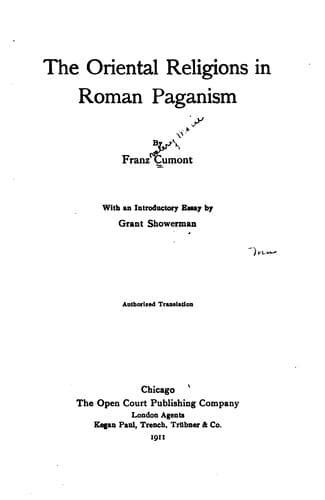
The Oriental Religions in Roman Paganism — John Shaqi
The Oriental Religions in Roman PaganismCumont, Franz
Religion
The Oriental Religions in Roman Paganism
Cumont, Franz
Paganism -- Rome; Religions; Rome -- Religion
But, as far as the Oriental religions are concerned, the results of all the
laborious investigations now being made in the classical countries can be
indirectly controlled, and this is a great advantage. To-day we are
tolerably well acquainted with the old religions of Egypt, Babylonia and
Persia. We read and translate correctly the hieroglyphics of the Nile, the
cuneiform tablets of Mesopotamia and the sacred books, Zend or Pahlavi, of
Parseeism. Religious history has profited more by their deciphering than
the history of politics or of civilization. In Syria also, the discovery of
Aramaic and Phoenician inscriptions and the excavations made in temples
have in a certain measure covered the deficiency of information in the
Bible or in the Greek writers on Semitic paganism. Even Asia Minor, that is
to say the uplands of Anatolia, is beginning to reveal herself to explorers
although almost all the great sanctuaries, Pessinus, the two Comanas,
Castabala, are as yet buried underground. We can, therefore, even now form
a fairly exact idea of the beliefs of some of the countries that sent the
Oriental mysteries to Rome. To tell the truth, these researches have not
been pushed far enough to enable us to state precisely what form religion
had assumed in those regions at the time they came into contact with Italy,
and we should be likely to commit very strange errors, if we brought
together practices that may have been {19} separated by thousands of years.
It is a task reserved for the future to establish a rigorous chronology in
this matter, to determine the ultimate phase that the evolution of creeds
in all regions of the Levant had reached at the beginning of our era, and
to connect them without interruption of continuity to the mysteries
practiced in the Latin world, the secrets of which archeological researches
are slowly bringing to light.
We are still far from welding all the links of this long chain firmly
together; the orientalists and the classical philologists cannot, as yet,
shake hands across the Mediterranean. We raise only one corner of Isis's
veil, and scarcely guess a part of the revelations that were, even
formerly, reserved for a pious and chosen few. Nevertheless we have
reached, on the road of certainty, a summit from which we can overlook the
field that our successors will clear. In the course of these lectures I
shall attempt to give a summary of the essential results achieved by the
erudition of the nineteenth century and to draw from them a few conclusions
that will, possibly, be provisional. The invasion of the Oriental religions
that destroyed the ancient religions and national ideals of the Romans also
radically transformed the society and government of the empire, and in view
of this fact it would deserve the historian's attention even if it had not
foreshadowed and prepared the final victory of Christianity.
* * * * *
{20}
WHY THE ORIENTAL RELIGIONS SPREAD.
Public-domain text, read in full here on John Shaqi.
Reviews
Reviews
No reviews yet
Be the first to share your thoughts on this work.
Join the Discussion
Join the discussion
Sign in to leave a comment or review.
Sign InorCreate an account