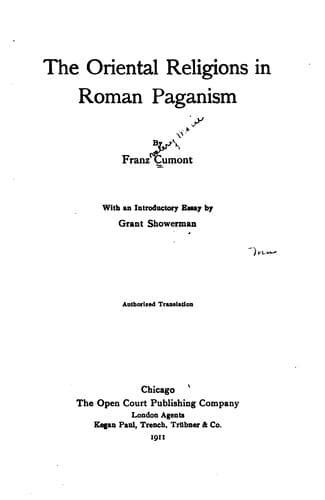
The Oriental Religions in Roman PaganismCumont, Franz
Religion
The Oriental Religions in Roman Paganism
Cumont, Franz
Paganism -- Rome; Religions; Rome -- Religion
When, during the fourth century, the weakened empire split asunder like an
overburdened scale whose beam is broken, this political divorce perpetuated
a moral separation that had existed for a long time. The opposition between
the Greco-Oriental and the Latin worlds manifests itself especially in
religion and in the attitude taken by the central power toward it.
Occidental paganism was almost exclusively Latin under the empire. After
the annexation of Spain, Gaul and Brittany, the old Iberian, Celtic and
other religions were unable to keep up the unequal struggle against the
more advanced religion of the conquerors. The marvelous rapidity with which
the literature of the civilizing Romans was accepted by the subject peoples
has frequently been pointed out. Its influence was felt in the temples as
well as in the forum; it transformed the prayers to the gods as well as the
conversation between men. Besides, it was part of the political program of
the Caesars to make the adoption of the Roman divinities general, and the
government imposed the rules of its sacerdotal law as well as the
principles of its public and civil law upon its new subjects. The municipal
laws prescribed the election of pontiffs and augurs in common with the
judicial duumvirs. In Gaul druidism, with its oral traditions embodied in
{21} long poems, perished and disappeared less on account of the police
measures directed against it than in consequence of its voluntary
relinquishment by the Celts, as soon as they came under the ascendency of
Latin culture. In Spain it is difficult to find any traces of the
aboriginal religions. Even in Africa, where the Punic religion was far more
developed, it maintained itself only by assuming an entirely Roman
appearance. Baal became Saturn and Eshmoun AEsculapius. It is doubtful if
there was one temple in all the provinces of Italy and Gaul where, at the
time of the disappearance of idolatry, the ceremonies were celebrated
according to native rites and in the local idiom. To this exclusive
predominance of Latin is due the fact that it remained the only liturgic
language of the Occidental church, which here as in many other cases
perpetuated a preexisting condition and maintained a unity previously
established. By imposing her speech upon the inhabitants of Ireland and
Germany, Christian Rome simply continued the work of assimilation in the
barbarian provinces subject to her influence that she had begun while
pagan.[1]
Public-domain text, read in full here on John Shaqi.
Reviews
Reviews
No reviews yet
Be the first to share your thoughts on this work.
Join the Discussion
Join the discussion
Sign in to leave a comment or review.
Sign InorCreate an account