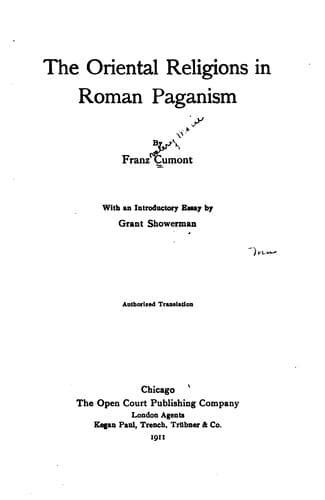
The Oriental Religions in Roman PaganismCumont, Franz
Religion
The Oriental Religions in Roman Paganism
Cumont, Franz
Paganism -- Rome; Religions; Rome -- Religion
This intimate union of erudition and faith continued {33} in the Latin
world. Theology became more and more a process of deification of the
principles or agents discovered by science and a worship of time regarded
as the first cause, the stars whose course determined the events of this
world, the four elements whose innumerable combinations produced the
natural phenomena, and especially the sun which preserved heat, fertility
and life. The dogmas of the mysteries of Mithra were, to a certain extent,
the religious expression of Roman physics and astronomy. In all forms of
pantheism the knowledge of nature appears to be inseparable from that of
God.[15] Art itself complied more and more with the tendency to express
erudite ideas by subtle symbolism, and it represented in allegorical
figures the relations of divine powers and cosmic forces, like the sky, the
earth, the ocean, the planets, the constellations and the winds. The
sculptors engraved on stone everything man thought and taught. In a general
way the belief prevailed that redemption and salvation depended on the
revelation of certain truths, on a knowledge of the gods, of the world and
of our person, and piety became gnosis.[16]
But, you will say, since in the classic age philosophy also claimed to lead
to morality through instruction and to acquaint man with the supreme good,
why did it yield to Oriental religions that were in reality neither
original nor innovating? Quite right, and if a powerful rationalist school,
possessed of a good critical method, had led the minds, we may believe that
it would have checked the invasion of the barbarian mysteries or at least
limited their field of action. However, as has frequently been pointed out,
even in ancient Greece the philosophic critics had very little hold on {34}
popular religion obstinately faithful to its inherited superstitious forms.
But how many second century minds shared Lucian's skepticism in regard to
the dogmatic systems! The various sects were fighting each other for ever
so long without convincing one another of their alleged error. The satirist
of Samosata enjoyed opposing their exclusive pretensions while he himself
reclined on the "soft pillow of doubt." But only intelligent minds could
delight in doubt or surrender to it; the masses wanted certainties. There
was nothing to revive confidence in the power of a decrepit and threadbare
science. No great discovery transformed the conception of the universe.
Nature no longer betrayed her secrets, the earth remained unexplored and
the past inscrutable. Every branch of knowledge was forgotten. The world
cursed with sterility, could but repeat itself; it had the poignant
appreciation of its own decay and impotence. Tired of fruitless researches,
the mind surrendered to the necessity of believing. Since the intellect was
unable to formulate a consistent rule of life faith alone could supply it,
and the multitudes gravitated toward the temples, where the truths taught
Public-domain text, read in full here on John Shaqi.
Reviews
Reviews
No reviews yet
Be the first to share your thoughts on this work.
Join the Discussion
Join the discussion
Sign in to leave a comment or review.
Sign InorCreate an account