The Oriental Religions in Roman Paganism — John Shaqi
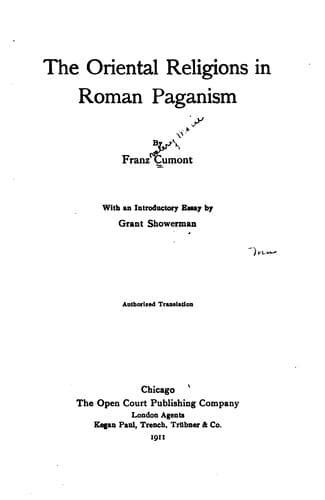
The Oriental Religions in Roman PaganismCumont, Franz
Religion
The Oriental Religions in Roman Paganism
Cumont, Franz
Paganism -- Rome; Religions; Rome -- Religion
to man in earlier days by the Oriental gods were revealed. The stanch
adherence of past generations to beliefs and rites of unlimited antiquity
seemed to guarantee their truth and efficacy. This current was so strong
that philosophy itself was swept toward mysticism and the neo-Platonist
school became a theurgy.
The Oriental mysteries, then, could stir the soul by arousing admiration
and terror, pity and enthusiasm in turn. They gave the intellect the
illusion of learned depth and absolute certainty and finally--our third
{35} point--they satisfied conscience as well as passion and reason. Among
the complex causes that guaranteed their domination, this was without doubt
the most effective.
In every period of their history the Romans, unlike the Greeks in this
respect, judged theories and institutions especially by their practical
results. They always had a soldier's and business man's contempt for
metaphysicians. It is a matter of frequent observation that the philosophy
of the Latin world neglected metaphysical speculations and concentrated its
attention on morals, just as later the Roman church left to the subtle
Hellenes the interminable controversies over the essence of the divine
logos and the double nature of Christ. Questions that could rouse and
divide her were those having a direct application to life, like the
doctrine of grace.
The old religion of the Romans had to respond to this demand of their
genius. Its poverty was honest.[17] Its mythology did not possess the
poetic charm of that of Greece, nor did its gods have the imperishable
beauty of the Olympians, but they were more moral, or at least pretended to
be. A large number were simply personified qualities, like chastity and
piety. With the aid of the censors they imposed the practice of the
national virtues, that is to say of the qualities useful to society,
temperance, courage, chastity, obedience to parents and magistrates,
reverence for the oath and the law, in fact, the practice of every form of
patriotism. During the last century of the republic the pontiff Scaevola,
one of the foremost men of his time, rejected as futile the divinities of
fable and poetry, as superfluous or obnoxious those of the philosophers and
the exegetists, {36} and reserved all his favors for those of the
statesmen, as the only ones fit for the people.[18] These were the ones
protecting the old customs, traditions and frequently even the old
privileges. But in the perpetual flux of things conservatism ever carries
with it a germ of death. Just as the law failed to maintain the integrity
of ancient principles, like the absolute power of the father of the family,
principles that were no longer in keeping with the social realities, so
religion witnessed the foundering of a system of ethics contrary to the
moral code that had slowly been established. The idea of collective
responsibility contained in a number of beliefs is one instance. If a
Public-domain text, read in full here on John Shaqi.
Reviews
Reviews
No reviews yet
Be the first to share your thoughts on this work.
Join the Discussion
Join the discussion
Sign in to leave a comment or review.
Sign InorCreate an account