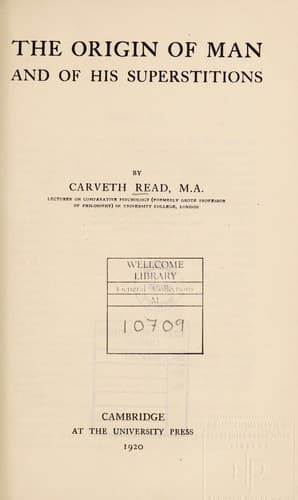
The Origin of Man and of His SuperstitionsRead, Carveth
Philosophy
The Origin of Man and of His Superstitions
Read, Carveth
Animism; Human beings -- Origin; Magic; Superstition; Totemism
The idea of a separable conscious personal force, or spirit, that
leaves the body at death, serves also, as it gathers strength, to
explain sleep, fainting, epilepsy; and sometimes every sickness is
attributed to the partial detachment or desertion of the spirit; which,
therefore, it is the doctor’s business to plug in, or to catch and
restore; or (if I rightly remember a report of Miss Kingsley’s) he may
even supply another one from a basketful of souls kept at hand for such
exigencies.
That the ghost theory arises not only from dreams, but is also
suggested by hallucinations and hypnagogic visions is very probable.
In various parts of the world savages have been described as having
visions of remarkably coherent and convincing vividness that seem not
to have been dreams.[180] But such experiences, even when artificially
induced by fasting or drugs (as happens among many tribes), are rare
in comparison with dreams; and to the influence of dreams upon these
savage beliefs there is abundant testimony. With some tribes dreams are
treated as part of their objective experience; so that to be injured
by your neighbour in a dream is just ground for avenging yourself as
soon as you wake; and to see a dead man in a dream is, therefore, clear
proof of his continued existence, and that either he has come to the
dreamer or the dreamer has gone to visit him.
Thus Sir Everard im Thurn says of the native of Guiana, his dreams are
as real as any events of his waking life; his dream-actions are done
by his spirit: in dreams he continues to see the dead—that is, their
spirits.[181] Similarly, the Lengua Indians (W. of R. Paragua) have
great faith in dreams; wherein the spirit is believed to leave the body
and to do in fact what is dreamed.[182] According to the Cherokees, to
dream of being bitten by a snake requires the same treatment as actual
snake-bite; else (perhaps years later) the same inflammation will
appear in the wounded spot, with the same consequences.[183] The Motu
hold that _sua_ (ghosts or spirits) are seen in dreams, and that when
a man sleeps his own _sua_ leaves his body.[184] “The Lifuans believe
in the reality of what is seen in a dream, and are influenced by it.
Their dead ancestors appeared in dreams.”[185] And the Polynesians of
Manatuki thought that “dreams were occasioned by the spirit going to
the places seen in them.”[186] Many more of such witnesses might be
cited.
Public-domain text, read in full here on John Shaqi.
Reviews
Reviews
No reviews yet
Be the first to share your thoughts on this work.
Elsewhere in the archive
Join the Discussion
Join the discussion
Sign in to leave a comment or review.
Sign InorCreate an account